
For firetruck enthusiasts, collectors, young aspiring firefighters, and emergency services professionals, understanding the requirements surrounding Commercial Driver’s Licenses (CDL) for operating fire trucks is crucial. Whether it’s the thrill of driving a massive vehicle or the day-to-day responsibilities in emergency services, the legalities that govern this operation are significant. In this exploration, we’ll dive deep into the necessity of a CDL when operating fire trucks, contextualize federal regulations alongside weight classifications, unpack state-specific exemptions, and illuminate the ramifications for firefighter training and operational safety. By the end, you will have a comprehensive understanding that will empower you to navigate the intricate world of fire truck operation legally and safely.
Licensing the Frontline: Navigating CDL Rules for Fire Apparatus
When a fire department considers replacing or augmenting its fleet, one question repeatedly rises to the surface with practical immediacy: will the driver need a Commercial Driver’s License to operate the fire apparatus? The answer is not simply yes or no. It depends on a constellation of factors—the vehicle’s weight, how it’s configured, and the regulatory frame inside which the department operates. In many parts of the country, the default assumption is that a CDL is required to drive a fire engine or ladder truck, because these vehicles are large, heavy, and built for public-safety missions. But that straightforward rule can be complicated by exemptions, local ordinances, and the realities of emergency operations. To navigate this terrain, responders and administrators must weigh federal guidelines against state rules, department policies, and the daily demands of the streets where turnout and rapid deployment can hinge on precise driving skills. The purpose of this chapter is not to overstate a rigid rule but to illuminate how licensing fits into the broader architecture of readiness and safety that governs modern firefighting.
On the federal side, the governing principle is the gross vehicle weight rating. A fire truck that weighs more than 26,000 pounds is typically treated as a commercial motor vehicle, and with that threshold comes CDL requirements. The same logic applies when a vehicle is designed to carry more than 15 people, including the driver. In practice, many engines, pumpers, and aerial devices land in that category. The licensing scheme is designed to ensure that operators of heavy and complex machines understand vehicle dynamics, braking distances, and the special considerations of operating on streets and in traffic with limited maneuverability. The result is that the driver’s license becomes more than a credential; it signals a baseline competency for handling a platform whose size and weight can influence public safety outcomes in a hurry. It is essential to note that the 26,001-pound line is a federal yardstick, but state and local jurisdictions often adapt it with their own interpretations for emergency operations, training, and mutual-aid assignments. The interaction between federal thresholds and state practice creates a mosaic in which the licensing requirement can vary across regions, even for the same model of apparatus.
Amid these thresholds, emergency exemptions represent a critical nuance. Some states provide exemptions that allow firefighters to operate fire apparatus without a CDL when they are performing authorized emergency duties. The logic is practical: during a call, the crew needs to reach the scene quickly, and the vehicle must be driven by a trained operator who can respond under pressure. However, exemptions are rarely blanket or universal. They typically depend on the vehicle’s role—emergency response in active service, not routine transport or training—and they may require the operator to be within certain driving conditions, such as driving to a location within defined proximity or under specific speed limits. In some jurisdictions, exemptions apply only when lights and sirens are active, or when the operator holds certain department-issued credentials beyond the CDL. These provisions can shift on a year-to-year basis as state laws evolve. The result is that while exemptions can reduce the formal licensing barrier in certain moments, departments still face a complex matrix of rules that govern when and where those exemptions apply, and what duties still require compliance with broader CDL standards.
Even when exemptions exist or when a vehicle may technically qualify for a non-CDL operation under some conditions, it is common for departments to require a CDL anyway. Modern fire apparatus are not mere trucks with ladders; they are moving laboratories of hydraulics, electronics, and safety systems. The license becomes a marker of training and capability to handle the vehicle under real-world stress. Endorsements, such as Class B, are often the baseline for heavy, non-passenger vehicles, while Class C might be appropriate for some configurations that have unusual passenger arrangements or specialized equipment. The driver must not only know how to steer and brake a heavy machine, but also how to operate a complex pump panel, manage electronic controls, and coordinate with a team that depends on precise driving to maintain a steady approach to a scene. Departments usually pair licensing with ongoing qualification processes, drills, and recertification to ensure any gaps are addressed quickly. In many agencies, the CDL pathway is viewed not as a hurdle but as a scaffolding that supports safety, accountability, and operational readiness, ensuring that the vehicle’s machine-driven capabilities do not outpace the driver’s competency. For readers who are curious about the broader landscape of fire apparatus operations and licensing, the Fire Truck Blog offers perspectives that complement formal certifications, serving as a useful reference point for policy discussions and practical considerations.
To translate licensing into daily life at a station, departments must balance the costs and practicalities. The CDL path usually entails training, testing, and time away from the apparatus for certification. Volunteers may carry CDL duties alongside other careers, which can complicate scheduling and budgets but also provides a clear standard for safe driving. In urban districts, departments may insist on the CDL as a baseline condition for any driver of heavy apparatus, while in rural areas exemptions may be more permissive but still complemented by local training requirements. The decision informs recruitment, retention, and the design of shift patterns so that crews have the stamina and situational awareness to perform under high stress. In sum, licensing is as much about future readiness as it is about current compliance. It anchors the broader safety culture that keeps drivers, passengers, pedestrians, and bystanders safe when a siren cuts through a quiet street. It also influences how maintenance and insurance are managed, since liability profiles change when a driver is explicitly licensed for heavy, complex equipment.
Because rules shift over time and can vary by state or locality, it is essential to verify current regulations with the right authorities. The standard starting point is to check the state DMV and the FMCSA for the latest guidance on CDL classifications, endorsements, and emergency exemptions that apply to fire apparatus. States often publish specialized guidance for emergency vehicles, including when exemptions apply, what training standards are required, and how a department can pursue waivers for cross-border operations. For a department evaluating a new or used engine, this isn’t academic; it directly shapes training schedules, vehicle commissioning, maintenance plans, and even procurement decisions. Licensing clarity helps ensure consistency when crews respond to mutual aid calls in different jurisdictions, reducing the risk of confusion or noncompliance during critical moments.
Consider, for a moment, the practical implications of a misaligned policy. If a department allows operation without a CDL in certain emergency moments but requires it for training or transport duties, the inconsistency can erode safety and undermine a unified response posture. Conversely, a rigid requirement for CDL across the board may slow down deployment or raise staffing costs in communities where drivers with the right endorsements are scarce. The best path blends federal requirements with sensible local rules, anchored by firm training standards. It treats the CDL not as a barrier but as an integrated element of the department’s standard operating procedure. When a new engine arrives, planners and training leads map out a certification timeline that aligns with maintenance and testing cycles, ensuring that on-call crews can reach any incident with confidence in their own skills and in the reliability of the vehicle they operate. This approach also supports cross-jurisdiction cooperation, since mutual-aid operations often involve crews from multiple agencies with varying licensing expectations.
Finally, for readers and policymakers drafting guidelines, the licensing question should be framed within the broader mission of emergency response: speed, safety, and accountability. The CDL decision influences who can drive, how often, and under what conditions, but it should never be treated in isolation from the vehicle’s capabilities, the crew’s training, and the community’s safety goals. The most effective departments embed licensing discussions into ongoing fleet governance, with clear criteria for when exemptions apply, how endorsements are maintained, and how training pipelines fit into annual budgets. In this integrated model, licensing becomes a handshake between federal standards, state adaptations, and local practice—a practical synthesis that keeps the engine and the team aligned with the street-level reality of emergency service. For further reflections on licensing and related operational issues, you can revisit the broader discussions in the Fire Truck Blog. Fire Truck Blog
From a reader’s standpoint, the essential message remains that the default expectation in the United States is that a CDL is typically required to drive heavy fire apparatus, even as the exact requirements bend with exemptions and local interpretation. The weight threshold, the seat count, and the vehicle’s role all carry weight in the regulatory conversation. The prudent path is to verify GVWR and seating with the appropriate authorities, understand which endorsements or exemptions may apply, and align training plans with the department’s operating philosophy and mission profile. In practice, empowering firefighters with a CDL-centric approach often enhances safety, reliability, and mutual-aid compatibility across jurisdictions, creating a workforce that can respond with confidence no matter where the call leads. The licensing framework thus serves as a backbone for the professional discipline of modern firefighting, one that supports complex operations and dynamic decision-making in the field. The evolving nature of firefighting technology means departments will continue to reassess licensing needs as new chassis, pumps, and safety features enter service, ensuring that policy and practice stay in step with the vehicles that carry the mission forward. For the official regulatory reference, consult the FMCSA CDL overview: FMCSA CDL Overview.
Do You Really Need a CDL for a Fire Truck? Understanding Weights, Exemptions, and Training
When a fire truck leaves the station, safety and readiness begin long before the siren. The question of whether a CDL is required hinges on how the vehicle is built, how it will be used, and which roads it will travel. In the United States, the FMCSA defines heavy vehicles and licenses them accordingly, and in most cases a fire apparatus that weighs above a certain threshold triggers CDL obligations. But the reality is more nuanced: state exemptions, department policies, and the emergency nature of the work all shape the actual licensing requirement.
The weight threshold often cited is a practical milepost: GVWR of 26,001 pounds or more places a vehicle into the CMV category under federal rules. That means many engines, tankers, and ladder trucks fall into a licensing zone, requiring the appropriate CDL class and sometimes endorsements. However, states may carve out emergency exemptions or allow operation without a CDL under specific conditions. It is essential to verify the current rules with the state DMV and the FMCSA before assuming an exemption applies.
Even when exemptions exist, many departments adopt a policy of CDL training for frontline operators. Modern fire apparatus can be complex, with advanced braking, hydraulic systems, and weight distribution that changes with water loads and equipment. The CDL framework helps ensure operators have the needed medical clearance, knowledge, and ongoing training to drive safely under stress.
For practitioners planning a licensing path, the guidance is simple: determine the GVWR of your primary response vehicles, review state exemptions for emergency driving, and align training with the department’s staffing realities. If in doubt, contact the state DMV and FMCSA for formal guidance, and review internal policies. The goal is to maintain safety, readiness, and regulatory compliance, without introducing unnecessary barriers to rapid response.
Do You Need a CDL for a Fire Truck? Understanding GVWR, Exemptions, and Practical Realities
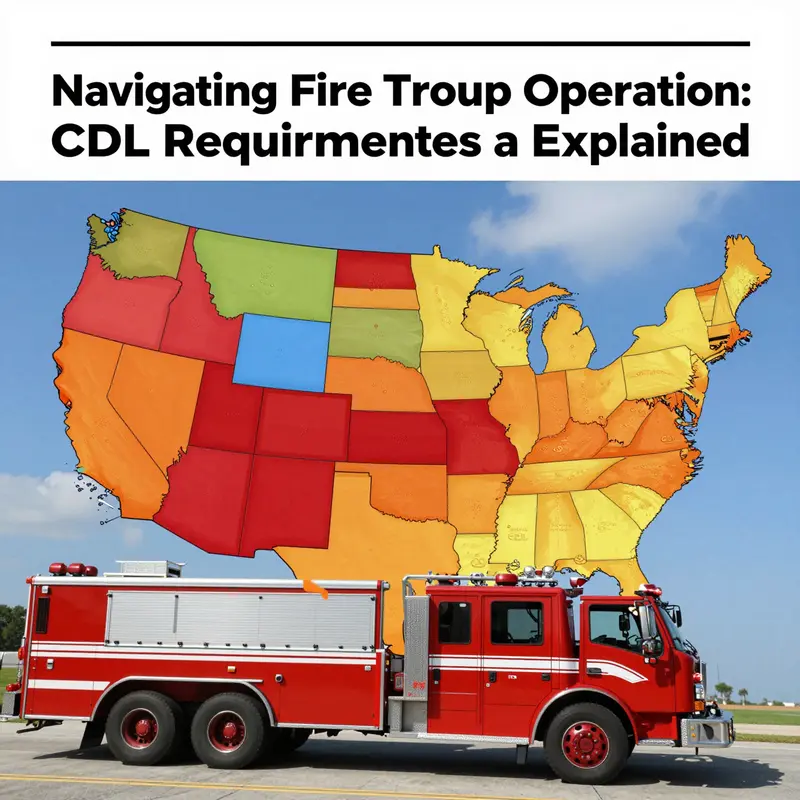
Fire trucks raise unique licensing questions because these vehicles are large, specialized, and used in high-stress emergencies. In practice, many departments treat them as commercial motor vehicles (CMVs) for weight-based CDL triggers, but exemptions and policy choices create a nuanced landscape. The Federal GVWR threshold of 26,001 pounds is the starting point: vehicles at or above this weight often fall under CDL requirements when operated on public roads under normal conditions. However, fire apparatus are not ordinary passenger vehicles, and exemptions exist at the state and federal level to facilitate rapid emergency response.
California, for example, has an emergency-exemption framework that relaxes CDL requirements for firefighters during active incidents or certain training activities. New York State offers a parallel approach. These exemptions generally apply only to emergency operations and may not cover routine maintenance, non-emergency transport, or training outside incident responses. Some states are more conservative and require CDL coverage for all operators of specific apparatus, regardless of context. The FMCSA also provides guidance recognizing emergency vehicle exemptions, aimed at removing regulatory friction in emergencies while preserving safety standards. The key idea is to balance speed and safety rather than eliminate licensing entirely.
Despite exemptions, many departments require CDL certification for all drivers who operate fire apparatus. Why? Because modern engines, pumpers, ladders, and aerial devices combine high system complexity with demanding handling, emergency-systems interfaces, and safety-critical decision making. A CDL program gives consistent, department-wide proficiency and simplifies training, testing, and audits. It also clarifies liability and governance around fleet operations.
Operationally, the exemption landscape is not a loophole to ignore licensing, but a set of scoped permissions. When a vehicle is used for non-emergency tasks, the exemption may not apply and CDL rules reassert themselves. Departments should verify the exact language in state statutes, DMV guidance, and FMCSA regulations, and document when exemptions are used. Fleet managers plan around certification requirements for staffing, training pipelines, testing slots, and ongoing refresher courses.
For individuals exploring career paths or equipment procurement, consider GVWR, vehicle configuration, and the department’s training plan. Some engines or brush units fall below the weight threshold and may not require a CDL in all circumstances, but many departments still train all operators to handle modern control systems and safety features. When evaluating new apparatus, factor licensing costs, maintenance implications, and the potential impact on response times and safety culture.
In sum, the CDL question for fire apparatus is not a simple yes or no. It depends on weight, operating context, jurisdiction, and department policy. The prudent approach is to verify regulatory details with the state DMV or equivalent agency and to align licensing, training, and operational procedures with current law. This ensures that life-safety duties can be performed quickly and safely whenever seconds count.
CDL Requirements for Fire Apparatus: Navigating Emergency Exemptions, Training, and Real-World Safety
When people first consider the question do you need a CDL for a fire truck, the instinct is often to assume yes. Fire engines are large, heavy, and operate on public roads much like other commercial vehicles. Yet the regulatory landscape around emergency response driving is nuanced. The core of the matter rests on federal exemptions designed for emergency vehicles and the practical realities that fire departments face every shift. Taken together, they form a framework in which a driver may operate a fire apparatus without a commercial driver’s license during emergencies, while safety, training, and local regulation remain paramount.\n\nAt the federal level, the Federal Motor Carrier Safety Administration recognizes that fire apparatus and other emergency vehicles have a distinct mission that often requires rapid deployment and movement of substantial weight. The key regulatory stance is an exemption that applies when emergency duties are being performed—when firefighters are responding to a call, en route to a scene, or returning from one. In those moments, the need for speed can be weighed against the slower, more conservative CDL process. This exemption is not a blanket permission to operate any large vehicle; it is a narrowly tailored allowance designed to support urgent mission readiness. The practical effect is that many firefighters can drive large fire apparatus without a CDL when they are performing firefighting operations or emergency response activities.\n\nNevertheless, the exemption applies under defined circumstances, and its reach is shaped by the specifics of the vehicle and the jurisdiction. A federally defined weight threshold matters: a vehicle with a gross vehicle weight rating over 26,001 pounds is typically in the realm where CDL considerations surface. In practice, many fire apparatus exceed it. The exemption thus interacts with weight in a way that invites careful interpretation by fire department leadership, drivers, and regulators alike.\n\nState and local variations add complexity. The federal exemption serves as a baseline, but states tailor rules to fit their traffic environments, public safety priorities, and resource realities. Some jurisdictions require a CDL for certain emergency operations or personnel categories, while others lean on department policy and training requirements to ensure safe operation. Departments must stay current with state DMV policies and FMCSA guidance, translating them into consistent operating procedures. The result is a system in which exemptions exist to save time, but safety and accountability remain essential.\n\nThe implications for training are profound. Even when the emergency exemption permits operation without a CDL, driving proficiency, safety awareness, and disciplined operation are nonnegotiable. Fire departments routinely supplement the exemption with targeted training that bridges general driving skills to the demands of heavy, complex apparatus. Training topics typically include defensive driving, vehicle handling under load, braking performance, and maneuvering in confined urban environments with pedestrians, cyclists, and other traffic.\n\nFinally, departments must balance legal allowances with practical readiness. Training often covers nonemergency operation, routine drills on public roads, and internal standards beyond minimum legal requirements. A strong program emphasizes risk management, communication, and decision making that protects the public as well as responders. The overarching message is that the license matters, but the readiness to apply skill and judgment under pressure defines effective emergency response.\n\nFor readers seeking practical context, consider sources that discuss mental readiness and core safety principles in the fire service, alongside broader federal guidance on exemptions and requirements for emergency vehicle operation.
Final thoughts
Navigating the requirements for a Commercial Driver’s License (CDL) in the context of fire truck operation is an essential responsibility for those involved in firefighting and emergency services. As we have explored, federal regulations set a high standard, emphasizing weight classifications, while state-specific exemptions can significantly impact the necessity of a CDL. Understanding these nuances not only aids aspiring firefighters in their journey but also enhances overall safety and preparedness within emergency services. Being well-informed provides a strong foundation for safely and effectively handling fire apparatus, ensuring readiness during critical moments. As you continue your journey, keep these insights in mind to confidently operate a fire truck, whether as an enthusiast or a dedicated professional.