
Fire trucks stand as symbols of bravery and swift action, racing through streets to save lives and property. Understanding how fast these essential vehicles can go reveals not just their engineering marvels, but also the varying missions they fulfill. From standard speeds crucial for emergency scenarios to extraordinary cases of modified fire trucks breaking records, speed plays a pivotal role in firefighting history and technology. This examination will guide firetruck enthusiasts, aspiring firefighters, and emergency services professionals alike through the intriguing world of fire truck speeds, focusing on standard response rates, record-breaking modifications, electric innovations, and various design factors that influence their capabilities.
Speed Under Pressure: How Fast Fire Trucks Go in Emergencies and What Governs Them
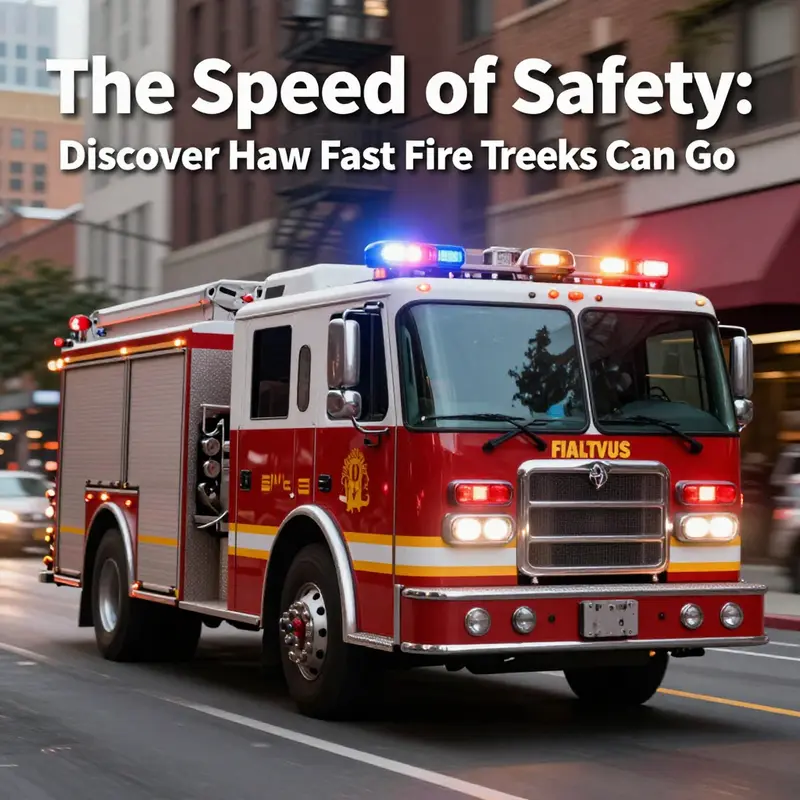
Speed under pressure is not a single number. It is a careful calculation that weighs urgency against risk, mission objectives against the safety of pedestrians, other drivers, and crew members. When people ask how fast fire trucks go, the instinct is to reach for a lone maximum figure. The reality is more nuanced: a given model may have a high top speed, but its day-to-day emergency performance is bounded by rules, road conditions, and the needs of the moment. Fire apparatus are engineered for rapid response, not runaway acceleration. Designers prioritize stability, braking, and visibility so responders can maneuver through crowded streets, negotiate intersections, and adjust speed without losing control or compromising safety.
The numbers matter, but context matters just as much. On paper, the top speed of many conventional pumper-type trucks sits in the 80 to 100 km/h range (roughly 50 to 62 mph) in optimal conditions. That is the vehicle’s ceiling, the limit of what the powertrain and chassis can deliver when the road is dry, visibility is good, and the projectiles of traffic are under control. In the real world, those top speeds rarely become daily practice. Urban environments, with traffic, pedestrians, and frequent stops, pull those numbers downward. The day-to-day pace in cities often lands in the 48 to 72 km/h band (about 30 to 45 mph) as crews balance speed with the need to navigate intersections safely, to merge with traffic, and to protect everyone on the road.
High-speed responses on highways tell a different story. When conditions allow—light traffic, clear sightlines, compliant weather—a unit may push close to the upper end of its capability. In such contexts, 88 km/h (55 mph) becomes plausible, provided that the jurisdiction’s rules permit it under the current conditions and that motorists are alerted to yield. It is essential to understand that top speed is a technical specification, not a standard operating tempo. The actual tempo of emergency driving is a function of time, place, and danger: the urgency of the call, the layout of the route, and the unpredictable behavior of other road users. Departments document and analyze these variables through drills and incident data, refining policies so that speed serves the mission without creating new risks for the public they serve.
The governing logic behind these practices extends beyond the engine room. Speed regulations in many U.S. jurisdictions recognize the need for rapid response while insisting on safety. Generally, fire apparatus may exceed posted speed limits by up to about 15 mph (24 km/h) when responding with warning lights and sirens. Yet this allowance is not universal. Local statutes, road conditions, and the specifics of the call influence how far responders can push, legally and practically. Across departments, this framework is reinforced through training that emphasizes precise vehicle handling, anticipation, and smoothness of motion. It is not enough to reach a destination quickly; arriving safely matters as much as arrival itself. The discipline is reflected in standards and guidelines that shape every aspect of emergency vehicle operations.
A comprehensive perspective on speed also requires acknowledging the variability of equipment and mission profiles. Conventional fire trucks are designed for a wide range of duties, from rapid initial attack to thorough suppression and rescue operations. Their top speeds are high enough to meet urgent needs on open roads, yet they are not optimized for breakneck acceleration. In urban cores, maneuverability and controllability are as crucial as outright velocity. Narrow streets, sharp turns, parked cars, and vulnerable pop-up hazards all demand careful pacing even when time is of the essence. For departments that require quieter, emission-free performance in dense neighborhoods, there are electric configurations that emphasize low-speed, high-torque operation suitable for close-quarters work. These compact electric response vehicles top out at modest speeds—around 26 km/h—with ranges near 80 km on a charge. They represent a different class of responding platforms: not fast pursuit machines, but capable, low-noise aids for specific urban roles like patrol, escort, and first-arrival situational assessment.
The spectrum broadens further when considering exceptional demonstrations rather than everyday firefighting. A highly modified, jet-powered demonstration vehicle built for airshows and record attempts achieved speeds well into triple digits during test runs. Such feats are dramatic and technically impressive, yet they bear little relation to real emergency response. They underscore the fact that when the goal shifts from suppression to spectacle, speed can be pushed to extraordinary extremes. In genuine fire operations, however, speed is tethered to safety, predictability, and regulatory compliance. The best practice is to use speed as a tool, not a weapon; to deploy it where it meaningfully reduces response time without compromising the safety of crews or the public.
The chapter would be incomplete without acknowledging how the speed question intersects with the broader ecosystem of standards and training. The National Fire Protection Association provides a framework that guides how fire apparatus are designed, bought, and operated. One element of this framework, referenced in the context of emergency vehicle operations, emphasizes that safety must be preserved even as response times are prioritized. The guidelines call for disciplined control, proper vehicle handling, and adherence to posted speed limits unless a legally excused exception applies. This approach helps maintain a balance between rapid arrival and the well-being of everyone on the road. For departments, the implications are practical: training programs simulate realistic driving scenarios, drivers practice hazard anticipation, and data from actual responses are used to refine policies and procedures. The overall objective is to optimize the speed-performance envelope so that the vehicle remains as reliable as it is fast.
For readers who want a broader view of how communities shape these choices, a visit to the Fire Truck Blog can provide additional context and case studies about emergency response practices and fleet considerations. Fire Truck Blog offers ongoing coverage that links the technical realities of vehicle performance to the lived experiences of responders in the field. The emphasis is not merely on how fast a truck can go, but on how speed, safety, and community needs come together in a coherent response strategy.
When we assemble these strands—the technical limits of the hardware, the regulatory guardrails, the situational realities of different environments, and the evolving mix of propulsion technologies—we arrive at a practical conclusion. There is no single number that defines how fast fire trucks go in emergencies. Instead, there is a speed continuum shaped by purpose, place, and policy. In urban theaters, the pace is deliberately moderated to protect bystanders and ensure orderly navigation through traffic. On open routes where conditions permit, crews may exploit higher speeds to shrink travel times. And as the fleet evolves, with quieter electric options and diversified mission profiles, the pace will continue to adapt while remaining anchored in safety and accountability. The core question—how fast do fire trucks go—retains a simple answer when reframed: they go as fast as the situation requires and permits, within a framework that keeps both responders and the public safe. External standards, practical experience, and ongoing training ensure that speed serves the mission without compromising the very safety it aims to protect.
For authoritative safety standards and further detail about emergency vehicle operations, refer to the official standards organization’s resources: https://www.nfpa.org
Beyond the Lights and Sirens: How Modified Fire Trucks Chase Speed Records and Why It Matters
Beyond the Lights and Sirens: How Modified Fire Trucks Chase Speed Records and Why It Matters
Fire trucks are purposeful machines: they carry people and heavy equipment, deliver water or suppression agents, and provide a mobile command post at chaotic scenes. Their design priorities are clear—stability, durability, payload capacity, and safe, predictable handling—yet curiosity persists about how fast they can go when you remove operational constraints. This chapter explores the rare world of speed-focused fire apparatus, examines why typical operational speeds are far lower than engineering possibilities, and explains what those extreme examples reveal about the trade-offs between velocity and firefighting effectiveness.
At the heart of any discussion about speed is context. Standard municipal and rural fire engines are optimized for prompt, reliable response rather than top speed. Most modern diesel-powered apparatus reach practical highway speeds in the range of 80–100 km/h (50–62 mph). That bandwidth reflects a balance: enough velocity to clear long distances quickly while preserving safety for crew, equipment, and other road users. These speeds are often constrained by legal limits, departmental policy, and the physical realities of heavy vehicles—center of gravity, braking distances, and the way mounted apparatus and water tanks affect handling.
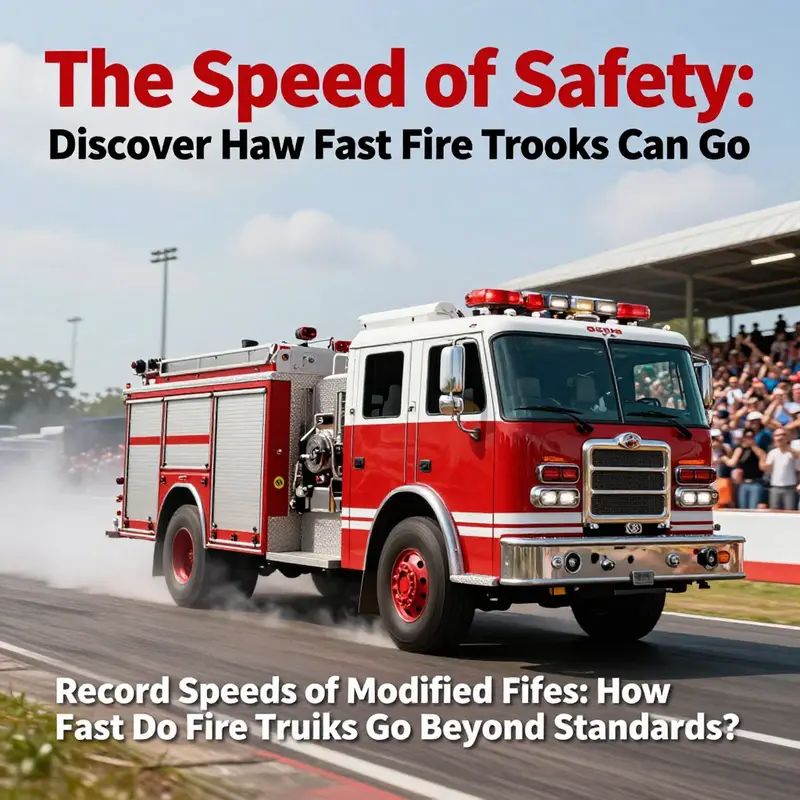
Contrast that with specially modified vehicles that have been pushed to extremes for promotional events, competitions, or record attempts. In these rare cases, engineers and builders set different goals. They may strip nonessential weight, reinforce frames, add high-performance engines, rework suspensions, and streamline bodywork. Without the need to carry ladders, hoses, or a full crew, some of these vehicles have exceeded 160 km/h (100 mph) and a few have pushed well past 200 km/h (125 mph). One historic outlier was a jet-powered conversion of an old chassis that reached speeds measured in the hundreds of kilometers per hour during a test run. Such feats are spectacular, but they exist as engineering showcases or entertainment, not as blueprints for operational apparatus.
Understanding why most fire trucks avoid high speeds means recognizing what happens to heavy, tall vehicles as velocity increases. Aerodynamics, while crucial for racecars, play a lesser role for boxy fire apparatus under normal use. More important are the dynamics of mass distribution and suspension travel. A loaded fire truck has a high center of gravity and significant unsprung mass—both factors that degrade cornering stability and amplify roll tendencies. Tires designed to support heavy loads and resist heat buildup typically have stiffer sidewalls and different tread characteristics than high-performance tires, which changes steering feedback and grip. Braking systems on emergency vehicles are robust, but stopping distances still increase substantially with speed, and fade becomes a concern if brakes are repeatedly stressed.
Then there is the equipment itself. Water tanks, aerial ladders, hose reels, and breathing-air cylinders are all heavy and often mounted high on the chassis. When apparatus are modified for speed attempts, many of these loads are removed or relocated. That transformation removes the real-world constraints that firefighters must live with. In operational service, a vehicle that corners or brakes poorly because of a lightweight, high-revving drivetrain would be more dangerous than one that arrives a few minutes later. Departments choose reliability and predictable handling because those traits save lives once the truck reaches the scene.
Regulatory frameworks and departmental policies also shape how fast fire trucks travel. Agencies set response-speed limits to reduce the risk of collisions while ensuring timely arrival. Training standards require drivers to master defensive driving techniques and to understand limits of vehicle handling at speed. Insurance and liability concerns further discourage pushing apparatus to performance extremes. Together, these factors explain why a department might operate an apparatus capable of higher speeds but restrict it to a conservative envelope during responses.
Specialized roles change the calculus slightly. Airport rescue and firefighting vehicles, for example, are often designed for higher acceleration and speed on long, clear runways. Their chassis and powertrains are selected to accelerate rapidly and to sustain higher speeds than a city pumper. Even so, these vehicles are engineered around different mission needs—rapid runway access and heavy agent delivery—so their speed capability is mission-specific rather than universally applicable.
Electric and low-speed urban apparatus add another dimension to the debate. In recent years, lightweight electric response vehicles have emerged for certain urban or campus duties. These designs favor quiet operation, low emissions, and maneuverability in dense areas. Their top speeds are intentionally modest—sometimes limited to 25–30 km/h (15–20 mph)—because they are tasked with local rapid-access duties rather than highway sprints. The trade-off here is clear: quieter, emission-free operation and lower operating costs in exchange for limited range and speed. For the missions they serve, that exchange is often worthwhile.
Public fascination with speed-record conversions can obscure the practical message: speed is one tool among many, and the fastest truck is not the most effective. A faster response time matters most when it reliably reduces travel time without increasing risk. The marginal benefit of pushing a heavy apparatus from 80 to 100 km/h is often far less than the increased risk of a serious crash. Departments that study response outcomes focus on system improvements—station placement, firefighter staffing, mutual aid agreements, and traffic preemption measures—because those strategies improve arrival times without placing crews at undue risk behind the wheel.
Still, high-speed experiments and demonstrations serve useful roles. They push engineering boundaries, spur innovation in powertrain and braking technologies, and capture public attention in ways that ordinary procurement cannot. The lessons learned from high-performance conversions—better cooling systems, stronger drivetrains, improved suspension tuning—can sometimes trickle back into mainstream apparatus design, informing incremental upgrades that improve reliability and handling at everyday speeds. That transfer of knowledge is a practical benefit of spectacle.
When assessing claims about exceptionally fast fire vehicles, skepticism is healthy. Record runs typically occur on closed courses under controlled conditions. Speeds achieved in those settings are not transferable to real-world emergency driving. It is also worth distinguishing between purpose-built experimental vehicles and conventional apparatus retrofitted for promotional activity. The former can be engineered from the ground up to balance speed and stability; the latter often remain heavy, unbalanced, and dangerous if driven aggressively.
For departments and communities, the most productive question is not how fast an apparatus can go, but how effectively it delivers service within acceptable risk. Fleet managers weigh vehicle performance against maintenance needs, lifecycle costs, and mission profiles. In many cases, investments in telematics, traffic-signal preemption, and strategically located small rescue units yield faster and safer reductions in response times than chasing higher highway top speeds.
If you want to explore available apparatus and variations in design, resources listing vehicles for sale and their configurations can be instructive; they show how different use cases generate different speed and performance trade-offs. A practical resource for comparing fleet options is a catalog of apparatus and their common configurations, such as those used in sale listings for municipal buyers.
Finally, authoritative testing and regulatory guidance provide clarity on what modifications are safe and legal. Agencies that study vehicle performance publish reports that address modifications, speed limits, and safety testing. These documents explain how changes to engine, suspension, or braking systems affect handling and crashworthiness. They are indispensable for any organization considering a nonstandard configuration.
External reference: For official guidance and testing information related to vehicle performance and modifications, see NHTSA Vehicle Performance and Testing.
Internal link: To review real-world apparatus offerings and typical configurations, see fire trucks for sale.
The bottom line is practical: fire trucks can be, and sometimes have been, pushed to remarkable speeds in controlled circumstances. Yet for everyday firefighting, speed must be balanced with safety, reliability, and mission effectiveness. High-speed demonstrations are interesting and occasionally instructive, but they do not replace sound vehicle design and smart operational policy when lives depend on controlled, predictable performance.
Silent City Responders: How Electric Fire Trucks Shape Urban Response Speeds
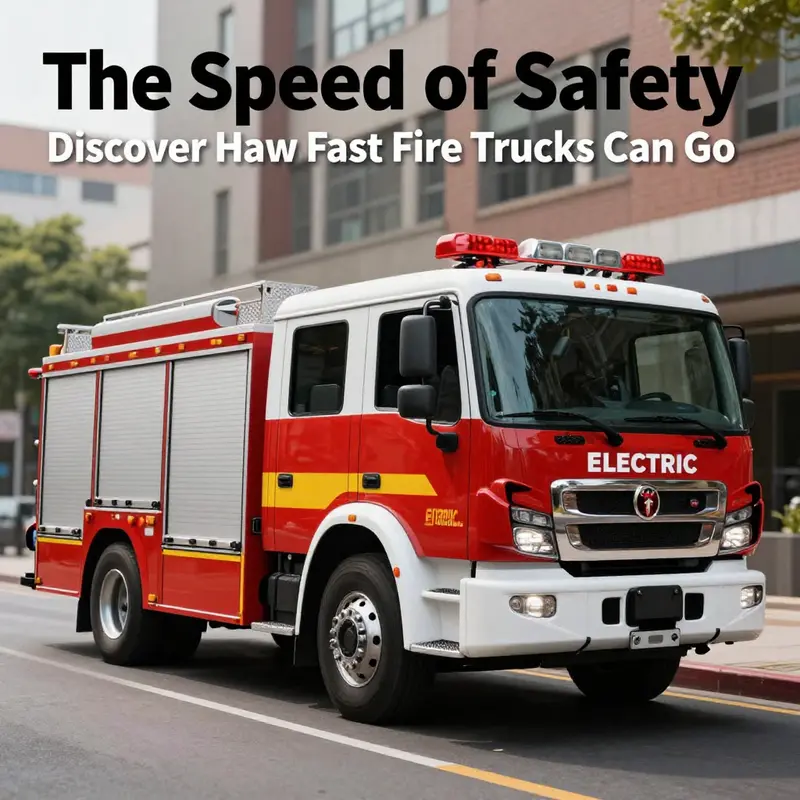
Electric fire trucks are changing how we think about speed in city emergencies. Their purpose is not to outrun every obstacle but to arrive safely, operate efficiently, and reduce emissions and noise on densely packed streets. In many urban centers, this trade-off means accepting lower top speeds in exchange for quieter, cleaner, and more maneuverable responses. Across a city, the demands placed on an emergency vehicle are complex: narrow lanes, pedestrian traffic, parked cars, and frequent stops. These constraints shape design choices, and speed limits are one of the most visible results.
Small electric fire trucks, often used for light-duty tasks, community responses, or as rapid intervention units, typically have modest performance specs. A one-ton utility model widely listed has a top speed of about 26 km/h. That figure initially sounds low when compared to diesel engines. Yet it reflects deliberate engineering choices. Lower maximum speed reduces the need for heavy, high-capacity batteries. It improves weight distribution for stability in tight turns. It also extends operational range within the start-stop reality of urban callouts. For many city assignments, such vehicles do not travel long distances at highway speeds. They are deployed for quick access, support roles, and operations where quiet presence and immediate water or medical support are more valuable than outright speed.
Larger electric apparatus that match conventional fire engines in size and payload exist, but they still follow a different operating logic. Their drivetrains may support higher speeds on open roads, yet drivers rarely push them to those limits inside a city. Instead, they cruise at speeds that allow safe maneuvering through intersections and around obstacles. Typically, emergency driving speeds for electric rigs in urban settings fall between 30–60 km/h, depending on congestion and the degree of urgency. These speeds maximize safety for crew and civilians. They also reduce strain on battery systems, allowing teams to remain operational on a single charge longer during a busy shift.
The practical speed of a fire truck in a city is governed by more than horsepower. Route planning, traffic signal pre-emption systems, and coordination with other responders influence how fast a vehicle can move. In dense neighborhoods, accelerating to high speeds is sometimes counterproductive. A fast approach can increase the risk of collisions and make it harder to position the vehicle precisely at the incident scene. Electric vehicles, by design, offer strong low-end torque. That feature aids in quick initial movement and precise control during slow-speed maneuvers. It also supports better handling when negotiating narrow alleys or curbs. Consequently, the benefits of electric drive systems are not measured only by top speed but by agility and responsiveness at the speeds that urban work actually demands.
Battery technology plays a central role in determining speed and range. Larger batteries enable higher sustained speeds, but they add weight and cost. Designers must balance payload capacity, water and equipment storage, and the vehicle’s center of gravity. A heavier battery improves highway capability, but it can compromise turning stability in built-up areas. For smaller city-oriented units, a smaller battery is often intentional. It keeps the truck light enough to maneuver and reduces the need for specialized charging infrastructure. Consequently, many municipal fleets adopt a mixed strategy: use compact electric units for rapid urban intervention and reserve larger diesel or hybrid rigs for highway travel or heavy-duty tasks.
Operational doctrine also shapes how speed features are used. Emergency vehicle driving protocols emphasize controlled speed and situational awareness. Even when vehicles are capable of higher speeds, crews adjust their approach based on scene complexity. Electric trucks, with their quieter operation, change perceptual dynamics. Pedestrians and other drivers may not hear them approaching, which places greater emphasis on visual warnings and controlled approaches. This reality encourages crews to maintain moderate speeds until they confirm a clear route through intersections. As a result, the effective speed advantage of a vehicle is often less about raw capability and more about the tactics used to move through traffic safely.
Maintenance and lifecycle costs factor into fleet decisions about speed and vehicle class. Electric drivetrains have fewer moving parts and can reduce maintenance downtime. Reduced mechanical complexity and regenerative braking extend component life when compared to conventional vehicles. Fleets can channel those savings into improved response planning rather than investing in high-speed upgrades. Over time, this reallocation supports a steady, reliable response model in which moderate speeds are acceptable and often preferable.
Public expectations also play a role in how fire services deploy electric trucks. Communities appreciate the lower noise and cleaner signals electric vehicles bring to residential neighborhoods. Instant acceleration and quiet operation decrease disturbance during night-time incidents. When a department adopts smaller electric units, it signals a shift toward community-focused response. The trade-off in top speed is usually acceptable to residents and managers, because these vehicles prioritize swift access and low impact over high-velocity travel.
Training adapts accordingly. Drivers learn to exploit electric torque for precise maneuvers. Crews practice positioning, so shorter runs compensate for lower maximum speeds. Dispatch protocols may change, too, routing faster conventional rigs when incidents are farther away, and sending electric rapid-intervention units to nearby locations. This layered response model keeps overall system speed high while leveraging the advantages of electric vehicles where they matter most.
Infrastructure is another decisive factor. Urban charging networks, depot chargers, and charging schedules influence how often an electric truck can be in service. Rapid chargers help minimize downtime, but their installation requires planning and investment. Where charging is limited, smaller battery packs and lower top speeds are practical compromises. They allow the vehicle to remain effective within a constrained operational radius. Conversely, cities that invest in robust charging infrastructure can support larger electric rigs with higher sustained speeds, though those rigs still face the same urban safety constraints.
Comparisons with conventional vehicles highlight the point that top speed is rarely the most critical metric for urban firefighting. Diesel trucks can reach higher maximum speeds on open roads, and that capability matters for rural and highway responses. In cities, though, the mission often involves getting to the incident quickly and then operating safely within a crowded scene. Electric fire trucks excel at that task because they combine torque, precise control, and quieter operation. Their intentionally lower top speeds align with safer urban tactics.
Finally, the pace of technological change suggests that electric urban fire apparatus will steadily improve. Battery energy density is increasing. Power electronics and thermal management are getting better. That progress will allow future vehicles to offer higher sustained speeds without sacrificing range or stability. Still, even with improved technical capacity, urban mission profiles will continue to favor measured, safe driving. The evolution will therefore be evolutionary rather than revolutionary: quieter, cleaner, and increasingly capable rigs that still respect the constraints of city life.
For a concrete reference on current urban electric apparatus specifications, see the product listing that documents a one-ton model with a 26 km/h top speed: https://www.alibaba.com/product-detail/Electric-Fire-Truck-1ton-Max-Speed-26-km-h_1600455812166.html. If you are exploring available vehicles, departments often list their inventory and sales resources online, such as listings for fire trucks for sale, which can help compare different classes of apparatus and how they balance speed, range, and payload: https://firetruck.space/fire-trucks-for-sale/.
Speed, Strategy, and the Fire Line: How Design and Environment Shape Fire Truck Velocity
Speed matters in emergency response, but the clock is not a blank slate. A fire truck’s velocity is a careful balance among design choices, load, and the world it travels through. When crews switch on the siren and lights, they are not simply chasing a number on a speedometer; they are entering a planning space where every kilometer per hour is weighed against braking distance, lane discipline, and the safety of people both inside and outside the cab. Speed becomes a measure of readiness tempered by risk and responsibility.
At the heart of speed is vehicle design. Engine power matters, but it does not operate in a vacuum. Fire apparatus must haul water, tools, hoses, and a crew, and payload directly affects acceleration, traction, and braking. A heavier chassis can carry more resources and offer stability, yet it typically accelerates more slowly and requires longer stopping distances. Braking systems, including anti-lock and well-tuned drivetrains, must match propulsion so momentum can be shed quickly and predictably.
Chassis and suspension influence handling at speed. A rigid, well-engineered frame provides stability for tight maneuvers, while a compliant suspension maintains tire contact and predictable steering. Drive configurations (rear-wheel, all-wheel, or other axle layouts) change acceleration, traction, and behavior under braking, and they are chosen to match the operational environment—urban streets, rural roads, or off-road tracks.
Environment often overrides engineering. Road type and surface determine how much of a vehicle’s capability can be safely used: open highways allow higher sustained speeds, urban grids impose frequent braking and tight steering, and unpaved or forest routes require reduced pace and careful handling. Weather and visibility further constrain usable speed: wet, snowy, or icy surfaces increase stopping distances; fog and heavy rain reduce sightlines; and high winds can shift loads or destabilize tall apparatus.
Traffic density and the presence of pedestrians, cyclists, and parked cars also limit practical speed. Even with sirens and lights, drivers typically proceed in incremental bursts, continually reassessing openings and hazards. Consequently, average speeds during emergency responses are often well below a vehicle’s theoretical maximum.
A useful way to view speed is as an operating envelope rather than a single figure. On a dry, straight highway a fire truck might approach its upper performance limit, but the objective remains minimizing risk. In urban or difficult terrain, the same vehicle will operate at much lower speeds to preserve control and safety. Thus, two apparatuses with similar engine outputs can show markedly different field performance depending on weight distribution, braking systems, suspension tuning, and operational context.
Emerging propulsion technologies change the balance among power, weight, and range. Electric and hybrid systems introduce heavy batteries that affect acceleration and handling but can offer quieter operation, lower emissions, and consistent torque delivery during frequent start–stop cycles. These designs often prioritize energy efficiency and reliability under duty cycles common to urban response rather than raw top speed.
Standards and operational practice emphasize that safe, predictable performance outweighs chasing maximum velocity. Industry guidance and regulatory bodies focus on braking ability, handling, and the reliability of systems under load. Training and protocols teach crews to anticipate traffic flow, adapt to surface conditions, coordinate with other responders, and position apparatus for optimal access—treating speed as a tactical asset governed by situational awareness.
In summary, how fast a fire truck goes is not a single number but a dynamic capability produced by vehicle engineering, payload, road and weather conditions, traffic, and disciplined driver decision-making. The most meaningful measure of speed in emergency response is how quickly a unit can arrive and operate safely at the scene, which depends on the interaction of design choices and environmental constraints rather than on top-speed specifications alone.
Final thoughts
In the world of firefighting, speed is paramount, but it varies significantly with the type and design of the fire truck. Standard models strike a balance between functionality and urgency, while modified trucks push the boundaries of speed in an extraordinary fashion. The emergence of electric fire trucks marks a new era of maneuverability, tailored for urban environments, reflecting modern needs for sustainability and efficiency. Understanding these diverse speed dynamics not only informs enthusiasts and aspiring firefighters but fortifies the foundation of effective emergency response strategies. Embracing these advancements ensures that firefighters remain prepared for the inevitable challenges they face each day.