
The battle against wildfires is a relentless and challenging endeavor that requires unity and collaboration among states. Recent rumors suggested a halt to the deployment of Oregon fire trucks in California, but the reality paints a much different picture of teamwork and resilience. This article delves into California’s ongoing cooperation with Oregon fire trucks, explores the interstate firefighting agreements that facilitate this collaboration, and highlights the critical role of mutual aid in wildfire management strategies. Together, these insights illuminate the camaraderie and commitment of firefighting professionals dedicated to safeguarding lives and communities from devastating fires.
Interstate Lifelines: California’s Ongoing Cooperation with Oregon Fire Trucks
When people ask whether California stopped Oregon fire trucks, the simple answer is this: it did not. The state’s wildfire response framework rests on a long-standing, deeply coordinated system built to move resources across borders in moments of crisis. The question itself reveals a broader concern about whether mutual aid is reliable or restricted. In truth, the opposite is the case. California continuously leverages its mutual-aid networks, drawing on neighboring states, including Oregon, to strengthen its firefighting capacity during large-scale wildfire events. The overarching principle is not sovereignty over scarce equipment but shared stewardship of landscapes that do not respect jurisdictional lines. The apparatus that underpins this cooperation operates through a constellation of formal agreements, dispatch centers, and interagency protocols designed to mobilize trucks, crews, and support services with speed and precision when fires demand rapid augmentation of local resources. In a landscape as dynamic as the western United States, the ability to call upon a coordinated, cross-state response is not a novelty but a necessity. The question thus becomes less about whether cooperation exists and more about how it functions when a fire season tests the limits of any single agency’s capacity.
That functional reality rests on a framework built from national and regional channels, with the Emergency Management Assistance Compact (EMAC) serving as the foundational mechanism for legal, operational, and logistical mutual aid across state lines. EMAC provides a standardized process for requesting, delivering, and reimbursing resources during emergencies. It reduces friction at moments when a fire front pushes into a terrain that communities alone cannot secure. California, like other states, maintains an active preparedness posture that anticipates the need for external assistance, not as a contingency but as a routine element of wildfire management. Within this framework, Oregon fire departments and CAL FIRE units have learned to treat each other not as distant neighbors but as integral components of a shared firefighting ecosystem. The practical effect is a fluid exchange of personnel, equipment, and expertise that can be scaled up or down to match the evolving intensity of a blaze.
A key arena for this cross-border collaboration is the National Interagency Fire Center (NIFC), which coordinates national firefighting resources and serves as a central hub for interagency dispatch. When a major wildfire erupts, NIFC can marshal crews and equipment from multiple states, including Oregon, and align them with California’s incident command structures. This alignment rests on a common operating picture, standardized incident command procedures, and pre-established channels for the transfer of missions, radio frequencies, and incident objectives. The end result is a response that looks seamless to the public, even though it is built on a complex tapestry of agreements, dispatch orders, and cross-state training exchanges that have accumulated over decades.
The 2023 wildfire season stands as a clear example of this dynamic in action. Oregon fire crews deployed to assist in California’s response, underscoring a principle that is central to the mutual-aid philosophy: resource sharing is a force multiplier, not a signal of weakness. When a seasoned engine crew from Oregon arrives on a California incident, they do not confront a new system but enter a well-practiced, mutually understood operating environment. The crews know the chain of command, the safety protocols, and the spell of a shared mission that transcends state borders. The transfer of knowledge is not one-way; California teams likewise contribute expertise in terrain management, weather interpretation, and large-scale incident management that can be brought to bear in Oregon when conditions demand it. The mutual-aid loop is therefore bidirectional and continuous, rather than a one-off transaction during a single event. This is the everyday reality of inter-state firefighting in the West, where the goal is resilience through redundancy and redundancy through cooperation.
Beyond EMAC, another pivotal agreement anchors this cross-border collaboration: the Northwest Wildland Fire Fighting Compact. This compact is a formal accord among U.S. and Canadian jurisdictions that governs the deployment of firefighting personnel and equipment across borders during emergencies. It codifies expectations for equipment compatibility, credential recognition, and cross-border dispatch procedures, reducing the friction that can arise when assets cross state or provincial lines. The compact’s reach extends beyond a single incident; it creates a persistent, accessible network through which California can request Oregon’s fire trucks and crews and, when necessary, offer a reciprocal exchange in times of extreme demand. The compact’s structure recognizes that wildland fires do not respect political boundaries, and it treats inter-jurisdictional cooperation as a strategic asset rather than a stopgap measure. For readers who want to explore the formal contours of this framework, the Northwest Wildland Fire Fighting Compact maintains a dedicated portal that outlines member jurisdictions, governing principles, and practical pathways for cross-border coordination.
Within this ecosystem, the process of mobilizing Oregon fire trucks into California’s wildfire response is a quietly orchestrated sequence. It begins with a request channel—often initiated by a local incident command post—backed by a standard set of data points: current fire behavior, resource availability, weather projections, and the status of available crews and apparatus. Dispatch centers, including CAL FIRE’s operational hubs and partner agencies’ desks, cross-check these inputs against the National Interagency Coordination System. If the assessment shows a deficit in local capacity, a formal request is transmitted to NIFC and, through EMAC, to the requesting state’s authorities and the responding state’s agencies. The responding entities prepare a drop-dead schedule for movement, which includes travel routes, staging areas, and safety considerations for movement through potentially congested corridors. When Oregon equipment and personnel are en route, they operate under California’s incident command structure once they arrive. This is essential to preserve unity of effort while ensuring that everyone speaks a common operational language, adheres to the same safety protocols, and follows a shared objective: saving lives, protecting property, and preserving natural resources.
The everyday reality of this cross-border workflow hinges on the interoperability of equipment and communications. Fire trucks and other apparatus are subject to standardized maintenance and certification regimes that facilitate rapid deployment across state lines. The Northwest Compact and related interagency agreements support cross-border equipment checks, radio compatibility, and compatible incident command software. When an Oregon engine arrives on California soil, the crew does not encounter a foreign system; they walk into a familiar operational environment that has already been harmonized through joint training and pre-arranged staging plans. This interoperability reduces the time between the moment a dispatch is issued and the moment the first effective defensive line is established. It also enhances safety, because the integration of crews means shared radio channels, standard operating procedures, and uniform safety briefings that are understood by everyone in the field. The net effect is a more robust and nimble wildfire response capability, capable of scaling up to meet landscape-scale fires that stretch resources thin across multiple jurisdictions.
An essential, albeit less visible, facet of this cooperation is the pre-season alignment of standards, training, and credentialing. The mutual-aid web is reinforced by joint training exercises, which practice the transfer of personnel and the migration of equipment across borders under controlled conditions. These exercises simulate real-world complications—from routing and staging to weather-driven shifts in fire behavior—and they cultivate a culture of trust among departments that might otherwise operate in separate silos. The value of this preparation becomes evident during the actual deployment when a California incident attracts fire crews from Oregon that arrive with a shared mental model. The crews know how to secure a water supply in unfamiliar terrain, how to coordinate with air support teams that may also be crossing lines, and how to operate within a unified command structure that blends multiple agencies into a single, coherent force. The emphasis on training and pre-planned shared procedures ensures that, even when the landscape is chaotic and the situation is life-threatening, the response remains coordinated, predictable, and safe.
Yet the terrain of mutual aid is not without its challenges. Jurisdictional boundaries, while porous in practice, can still pose differences in regulatory frameworks, workforce certifications, and equipment specifications. Radio frequencies might require careful coordination to maintain clear lines of communication across agencies, especially when multiple dispatch centers are linked to a single incident. Weather conditions can alter the effectiveness of certain apparatus on rugged terrain, requiring on-the-fly adjustments to tactics and resource use. These hurdles are precisely why the Northwest Compact and EMAC are continually referenced in planning documents and training regimes. They provide the legal and operational scaffolding that allows California to request Oregon’s fire engines without wresting with a patchwork of incompatible procedures. The ongoing dialogue that accompanies these agreements helps ensure that when a fire season peaks, the system does not crumble under pressure, but instead works as a well-practiced orchestra where every instrument understands its cue and its cadence.
From a public perspective, the regular cross-border exchange may seem almost invisible, but it is deeply consequential. Residents in California’s wildland-urban interface benefit from the added capacity that Oregon crews bring during the most severe days of the season. They see fewer neighborhoods suddenly endangered by rapidly advancing flames, and they experience shorter evacuation windows due to more efficient containment lines and faster resource deployment. For Oregon communities, the reciprocal benefit is clear: shared training, shared risk, and a broader sense that during catastrophic events, no one stands alone. The mutual aid ethos, reinforced by formal agreements and practical routines, becomes a safeguard against the fear that a distant line on a map marks the boundary of responsibility. In reality, the boundary is porous because cooperation has created a shared border where competence, speed, and safety travel as a single force.
As the mutual-aid system continues to evolve, the role of leadership in both states becomes crucial. Agency heads, incident commanders, and interagency liaison officers work together to sustain a culture of openness and rapid decision-making. Clear communication about resource needs, availability, and capabilities is emphasized in every briefing. In the end, what matters most is not the rhetoric surrounding cross-border cooperation but its operational efficacy during the most challenging moments of a wildfire season. The chapters of this cooperation read like a living document—less a declaration of intent and more a record of practiced, repeated success in the face of danger. When the winds rise and the flames advance, the story that matters is the one where California can lean on Oregon, Oregon can lean on California, and together they can bend the arc of a fire toward containment rather than catastrophe. This is the essence of interstate firefighting in the modern West: not a question of whether help is available, but how quickly help can arrive in the right form, properly integrated into a shared mission.
For readers seeking a concise orientation to the structural backbone of this cooperation, the Northwest Wildland Fire Fighting Compact offers a clear map of the participating jurisdictions and the mechanisms by which cross-border support is mobilized. The compact is more than a policy document; it is a living network that enables the rapid movement of engines, crews, and equipment across political boundaries during emergencies. The practical demonstrations of this framework—Oregon crews deploying to California during peak fire activity and California units reciprocating when conditions demand—are not isolated incidents but components of a broader, predictable pattern that undergirds modern wildfire management in the region. The pattern is reinforced by the commitment of both states to trained personnel, interoperable equipment, and a shared sense of mission that values human life and ecological resilience as top priorities. The result is a wildfire response system that remains robust under pressure, flexible enough to adapt to shifting conditions, and consistent in its underlying principle: mutual aid is a strategic asset, not a last resort.
As the narrative of inter-state cooperation continues to unfold, readers may encounter discussions about broader command concepts, such as unified command that bring multiple agencies into a single operational framework. This approach, described in various professional resources and practice guides, underscores how effective cross-jurisdictional responses hinge on shared objectives, clear roles, and synchronized decision-making. To explore that angle further within the context of emergency response, consider the concept of unified command as a practical anchor. It emphasizes the alignment of priorities across agencies, the harmonization of tactics, and the prioritization of safety and efficiency in the field. This alignment, in turn, strengthens California’s and Oregon’s willingness to share fire trucks and crews because it reassures all participants that they are operating under a common plan with common end goals. The real-world impact is visible not only in the speed of resource deployment but in the confidence with which teams operate alongside one another when the fire line advances and the clock tightens. In this sense, interstate cooperation becomes not just a policy for resource sharing but a disciplined practice of joint action that preserves lives, homes, and landscapes when it matters most.
For readers who wish to dive deeper into the practical elements of cross-border coordination, a useful entry point is the internal discussion about unified command and its applicability to interagency responses. You can explore it in more detail through this resource: Unified Command in Emergencies. Beyond the theoretical framework, the practical implications include shared briefings, aligned safety standards, and the ability to reallocate assets with confidence that the receiving unit can integrate seamlessly into the incident’s strategic objectives. This is not about surrendering local control but about embracing a broader operational logic that treats wildland fire as a regional, rather than a purely municipal, concern. The result is a more resilient system—one that recognizes the interdependence of communities, landscapes, and the people who defend them. The ongoing collaboration between California and Oregon fire departments, backed by the Northwest Wildland Fire Fighting Compact and reinforced by national interagency coordination, offers a model of mutual aid that other regions may study for lessons about preparedness, interoperability, and shared responsibility.
As this chapter concludes, it is important to reinforce the central takeaway: California has not stopped Oregon fire trucks; it has deepened the mutual-aid arrangements that make cross-border response possible. The coordination is not a one-time emergency response; it is a sustained, normalized practice embedded in planning, training, and interagency cooperation. From the long-standing doctrine of EMAC to the formal commitments of the Northwest Compact, the system works because it is designed around common goals and a shared recognition that wildfires require collective action. Oregon’s engines are not visitors; they are partners in a regional effort that uses every tool at hand to protect people, property, and the environment from the threat of wildfire. In this sense, the question about stopping or not stops becoming a misframe. The real question is how quickly, efficiently, and safely can cross-border assistance be mobilized when the next fire season comes with its familiar blend of heat, wind, and urgency. The answer remains clear and hopeful: cooperation persists, and it remains the cornerstone of effective wildfire management across the California-Oregon frontier.
External resource note: For a deeper dive into the formal framework that enables cross-border firefighting cooperation, you can consult the Northwest Wildland Fire Fighting Compact’s official materials at https://www.nwfirecompact.org. Internal resource for readers seeking a practical overview of unified command concepts can be explored through this internal reference: Unified Command in Emergencies.
Across State Lines in the Fire Season: Debunking the Myth That California Stopped Oregon Fire Trucks
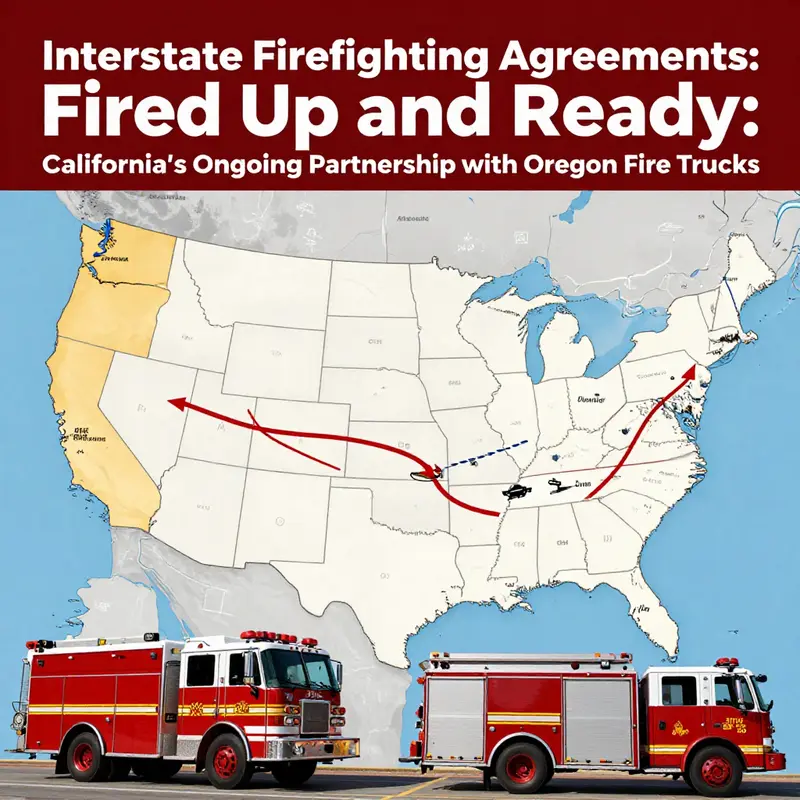
When wildfires flare across the western United States, the firefighting landscape becomes a study in logistics, coordination, and intergovernmental trust. The public often latches onto dramatic narratives—stories of barriers at borders, or dramatic refusals to lend aid across state lines. Yet the record, evaluated against agency statements, interagency agreements, and the cadence of real-world deployments, shows a different picture. The question, “Did California stop Oregon fire trucks?” resists a simple yes-or-no answer because the relationship between California and Oregon in wildfire response is governed not by one policy, but by a dense framework of mutual aid agreements, emergency management protocols, and cross-border cooperation that is designed to flow resources where they are most needed, as quickly as possible. In practice, California and Oregon have long-standing, mutually reinforcing arrangements that keep engines, crews, and equipment moving across the line when fires demand it. The myth of a border wall blocking aid has more often arisen from miscommunications, temporary bottlenecks, or sensational reporting than from deliberate policy decisions to restrict assistance.
To understand why the myth persists less as a policy question and more as a narrative, it helps to unpack the machinery that enables interstate firefighting. At the core is a network of agreements and centers that coordinate the entry of resources from one state into another during emergencies. The National Interagency Fire Center (NIFC) serves as a national hub for firefighting resources. It does not crown winners in a firefight; it orchestrates a broader, multi-agency response that leverages assets wherever they can best contribute to suppressing a wildfire. When a state is overwhelmed, it can request assistance through established channels that connect local and state agencies with regional and national responders. This is not a unilateral request placed in a void; it is a structured process that aligns with federal and state authorities, ensuring that engines, crews, and support personnel arrive with the right qualifications, at the right time, and under appropriate supervision.
An essential element of this system is the Emergency Management Assistance Compact (EMAC). EMAC provides the legal framework for cooperation across state lines, facilitating the deployment of personnel, equipment, and resources from neighboring states. For California, Oregon, Washington, and the other Western states, EMAC has become a predictable mechanism that speedily unlocks mutual aid during large-scale wildfires. The approach is not merely about sending a set number of fire engines northward or southward; it’s about harmonizing incident management structures so that a cross-border deployment can function within an established chain of command. This alignment reduces confusion, accelerates response times, and helps agencies avoid duplicative efforts on the ground.
The practical operation of interstate firefighting is a study in timing and logistics. When a major fire season begins, CAL FIRE, like its peers in neighboring states, maintains an ongoing readiness posture. This means prepositioned equipment, trained personnel, and formalized lines of communication that can be activated quickly. The California Department of Forestry and Fire Protection, or CAL FIRE, operates within the broader mutual-aid ecosystem that includes EMAC and NIFC. Their interstate assistance page outlines how the state coordinates with others to request and receive help. The page emphasizes that California does not block or limit assistance from other states; rather, it describes procedures that ensure aid flows smoothly across borders when needs exceed local capabilities. This framework is echoed across agencies in Oregon, Washington, and beyond, reinforcing the point that cross-border cooperation is an intentional and ongoing practice, not a reaction to a single incident.
In recent years, this cooperative posture has been exercised repeatedly. During the 2023 wildfire season—and continuing into 2024—Oregon fire crews were deployed to California to support suppression efforts. These deployments demonstrate that mutual aid is a dynamic process, capable of scaling up as fires intensify and crossing state lines becomes a practical necessity. The presence of Oregon engines working on California fires is not anomalous; it reflects a shared understanding that the most effective suppression outcomes depend on pooling resources and expertise in real time. It is also a reminder that the basic premise of mutual aid is reciprocal. California, in turn, contributes to Oregon’s capacity when the scales tilt toward Oregon’s own wildfire pressures. The reciprocity is a defining feature of the interdependent West, where fire seasons can overwhelm a single state’s resources regardless of how well they are organized within their own borders.
Yet public perception often latches onto momentary hiccups as evidence of policy decisions. In 2023, there were reports—amplified by the 24-hour news cycle and social media—that suggested delays at the border as Oregon fire trucks entered California. Investigations and clarifications from responsible agencies indicate that those instances were not a rejection of aid but rather a confluence of procedural and logistical issues. Temporary administrative coordination procedures, traffic management challenges, and scheduling realities can create bottlenecks at border crossings or within border counties. These are the kinds of constraints that arise whenever complex systems handle large numbers of moving assets across jurisdictional boundaries. They are not statements about the willingness of one state to accept help from another. In the grand scheme of interstate mutual aid, they are minor blips in an otherwise well-trodden path toward shared suppression efforts.
What do these stories teach us about the nature of intergovernmental cooperation during emergencies? They reveal that the strength of the firefighting enterprise across state lines lies in its structured flexibility. The same frameworks that allow CAL FIRE to authorize a cross-border strike team also enable the state to coordinate with Oregon through standard operating procedures, common incident command structures, and established reporting channels. The concept of unified command in emergencies—though not always visible to the public—provides the backbone for such coordination. When diverse agencies converge on an incident, they must speak a common language, share situational awareness, and align objectives. The unified command approach, often discussed in professional circles and training materials, ensures that responders from California and Oregon can work side by side without step-by-step micromanagement from distant authorities. This is not a theoretical ideal; it is a practical framework that appears repeatedly in the field, enabling responders to synchronize tactics, share maps and weather data, and assign tasks without bureaucratic friction.
For readers who want to see how these principles play out on the ground, the broader mutual-aid ecosystem provides several concrete touchpoints. The National Mutual Aid Agreement—though not a single paper but a network of state and federal commitments—ensures that equipment and personnel can flow across borders with a shared understanding of rates, eligibility, and accountability. FEMA’s involvement adds another layer of practical support, offering resources, guidance, and coordination that help streamline the process during large-scale incidents. In California, the interstate assistance mechanism is explicitly described as a conduit for cooperation, reinforcing that the state’s posture toward Oregon and other neighbors is one of openness and readiness rather than suspicion or withdrawal. The takeaway is simple: the system is designed to prevent a blocking posture, and the anecdotal narratives that imply a border shutdown do not align with documented practices or the lived experiences of responders.
This is not an argument that everything goes perfectly every time. The reality of cross-border firefighting includes imperfect communication, intermittent outages in radio coverage, and the occasional mismatch between a crew’s available deployment window and the immediate needs on a growing fire. These are logistical realities that any large-scale emergency response faces, not evidence of political hostility or policy-based refusals. They are, in many ways, the price of resilience—an resilience built on decades of interagency learning, joint training exercises, and continuous improvement. The interagency culture that has developed around wildfire response emphasizes transparency, accountability, and adaptability. Fire chiefs, incident command teams, and state emergency managers routinely review past deployments, identify bottlenecks, and revise procedures to prevent repetitive delays. The net effect is a system that learns from its own imperfections and, crucially, keeps the door open to neighbors who are ready to help when fires threaten homes, communities, and landscapes across borders.
Readers curious about the day-to-day mechanism of this cooperation will find the practical truth in the alignment of command structures, the legal frameworks that enable cross-border response, and the steady stream of joint exercises that keep responders prepared to work together. The coordination is not a one-off event; it is an ongoing practice. Fire engines from Oregon traveling to California, and California personnel reciprocating to respond to fires elsewhere, arise from the deliberate design of mutual aid arrangements and the trust that underpins them. The larger point is that inter-state collaboration in wildfire suppression is not about charity or political goodwill alone. It is about the survival of communities and the efficient use of scarce resources during a climate of increasing fire frequency and intensity. The record shows that California has not stopped Oregon fire vehicles; rather, California and Oregon have continued to press resources toward the most critical fires, guided by established channels and shared urgency.
As with any public conversation about public safety, precision matters. The nuance lies in distinguishing between a policy decision that blocks aid and the everyday realities of deploying resources across a dynamic, evolving incident landscape. When a border crossing experiences a short delay, the explanation is rarely a policy choice. It is typically a matter of coordinating the timing of arrivals with fire behavior, road conditions, and on-scene priorities. The fact that agencies publicly acknowledge these timing challenges demonstrates a level of accountability that is essential to maintaining trust in mutual aid. It is also a reminder that the firefighting enterprise is a human-driven operation, reliant on clear communication, coordinated logistics, and the ability to adapt as fires threaten new areas or shift directions due to weather. In that sense, the partnership between California and Oregon stands as a case study in effective cross-jurisdictional cooperation, one that has persisted through years of intense fire seasons and evolving best practices.
For those who want to explore further how these agreements are structured and administered, the principle takeaway is that the system exists to facilitate, rather than to restrict, cross-border assistance. The dashboard of mutual aid includes established channels, standard operating procedures, and formalized expectations about who provides what, when, and under whose command. The experience of Oregon crews assisting California in 2023 and 2024 is not an anomaly but a reaffirmation of the mutual-aid ethos that binds Western wildfire response. It demonstrates how, even under stress, established agreements and professional norms can translate into real-world outcomes: fires are fought with the knowledge, equipment, and manpower of multiple states, converging toward a common objective—the protection of lives, homes, and landscapes.
As this chapter threads through the broader arc of the article, the bigger picture becomes clear. California did not stop Oregon fire trucks; it relied on a long-standing, well-practiced system designed to get help where it’s needed, when it’s needed. The occasional border delay is a logistical footnote in a much larger record of collaboration, shared training, and mutual support. The conversation about interstate firefighting is healthier when it centers on the mechanisms that enable cooperation and the outcomes those mechanisms produce. Readers can carry forward the understanding that mutual aid is not an act of charity but a strategic and operational necessity—one that allows neighboring states to act as a single, coordinated force when wildfires demand more than one jurisdiction can provide alone. That is the essence of cross-border resilience in the firefighting realm, and it remains the steady reality behind every Oregon engine that reaches a California fire line, and every California crew that answers a call beyond its own borders.
If you’re seeking a concise thread through the procedural landscape that undergirds these deployments, consider how unified command and EMAC work in concert to legalize, coordinate, and normalize cross-border response. The practical implications are straightforward: when the weather turns hostile and fires rapidly expand, mutual aid is not optional—it is built into the system from the ground up. The public narrative may swing toward dramatic anecdotes, but the professional account rests on a foundation of interagency trust, formal agreements, and a shared commitment to preserving communities across state lines. This is how California and Oregon, and other neighboring states, consistently rise to the challenge of a compounding wildfire season, turning potential bottlenecks into bridges that connect responders to those who need them most.
Internal link for further context on how modern emergency response systems strive for seamless collaboration across agencies can be found here: Unified Command in Emergencies.
External resource for a detailed overview of interstate assistance practices in California: https://www.fire.ca.gov/interstate-assistance/.
Mutual Aid as a Lifeline: California, Oregon, and the Shared Front in America’s Wildfire Battle
When California and Oregon mobilize firefighting resources across state lines, mutual aid relies on formal agreements, standardized procedures, and coordinated command. EMAC, the National Interagency Fire Center, CAL FIRE, and unified command structures create a scalable, interoperable response that can surge resources quickly while maintaining safety and accountability. The mutual aid network enables engines, hand crews, water tenders, aircraft, and other equipment to be deployed within hours of a call, ensuring communities have protection when fire activity spikes. This system is designed to be a long-term, adaptable capability rather than a temporary fix, and it remains a core element of California’s wildfire resilience as climate-driven risks intensify.
Final thoughts
The partnership between California and Oregon in wildfire management showcases the strength of collaboration and mutual aid in the face of adversity. As fire seasons become increasingly intense, the importance of these interstate agreements and support networks cannot be overstated. By standing together, states can effectively share resources, expertise, and manpower, ultimately enhancing their firefighting capabilities. This spirit of teamwork not only helps protect lives and property but also fosters a culture of resilience and readiness for future challenges. As firefighters and emergency services professionals continue to work side by side, they exemplify dedication and unwavering commitment to safeguarding our communities.