
When it comes to the world of emergency services, few pieces of equipment are as awe-inspiring and vital as the fire truck ladder. These towering extensions of firefighting ingenuity not only reach incredible heights but also provide a lifeline to those trapped in perilous situations. Imagine the thrill of watching a fire truck deploy its ladder, stretching high into the sky, ready to save lives and combat fiery infernos. Each fire truck ladder is equipped with state-of-the-art technology designed to enhance safety and efficiency during rescue operations. These remarkable tools are essential for firefighters, enabling them to access multi-story buildings and tackle emergencies with confidence. Whether you’re a firetruck enthusiast, an aspiring firefighter, or a seasoned emergency services professional, understanding the capabilities of this crucial firefighting equipment can deepen your appreciation for the brave work done in the field. Learn more about firefighting innovations and the evolution of fire truck ladders.
History of Fire Truck Ladders
The evolution of fire truck ladders is a fascinating journey marked by ingenuity and necessity. From humble wooden origins to sophisticated modern technology, these ladders have significantly enhanced firefighting capabilities. Here’s a timeline of key advancements in fire truck ladder technology:
Timeline of Fire Truck Ladder Evolution
| Year | Milestone | Description |
|---|---|---|
| 1847 | First known fire ladder | Early manual ladder used by firefighters, typically made of wood and limited in height and reach. |
| 1875 | Rotating aerial ladder invented | Introduced the ability to rotate the ladder, allowing better access to different sides of a building. |
| 1900s | Transition to motorized vehicles | Fire trucks began using internal combustion engines, improving speed and mobility compared to horse-drawn models. |
| 1950s | Introduction of fully articulated ladders | Multi-section ladders with joints allowed greater flexibility and reach around obstacles. |
| 1960s | Telescoping ladders | Ladder sections could extend and retract, increasing reach while maintaining compact storage. |
| 2000s | Smart technologies integrated | Modern fire trucks include computerized controls, sensors, GPS, thermal imaging, and automated stabilization systems for improved safety and efficiency. |
Significant Advancements
- Rotating Aerial Ladder (1875): Developed by Johann Adam Stahl, this was the first ladder to rotate, which transformed how firefighters could approach buildings. This innovation allowed for better positioning during emergencies.
- Motorization (1900s): The transition from horse-drawn to motorized fire trucks meant faster response times and the capability to carry larger ladders. This innovation fundamentally changed firefighting tactics and accessibility.
- Telescoping Ladders (1960s): These ladders could extend up to 100 feet, which was revolutionary for reaching taller buildings and enabled safer rescues. They maintained structural integrity, allowing firefighters to work at greater heights without compromising safety.
- Smart Technologies (2000s): Modern fire trucks are now equipped with onboard computers and sensors that enhance operational safety and efficiency. Features like automatic stabilization, thermal imaging, and GPS aid firefighters in emergencies, making their work less hazardous and more effective.
The advancements in fire truck ladders reflect a commitment to safety and efficiency in firefighting. These innovations have not only improved the ability to combat fires but also ensured the safety of firefighters and the communities they serve. For more insights into the evolution of fire apparatus, learn more about firefighting history here.

As aspiring firefighters and fire enthusiasts continue to study the history and development of firefighting technology, it serves as inspiration for the future of firefighting and rescue operations.
Comparing Fire Truck Ladder Heights
In the world of firefighting, ladder trucks are crucial for reaching high-rise buildings and performing rescues. Below is a table comparing the maximum heights of various fire truck ladders, along with their specifications and notable features:
| Type | Maximum Extended Height | Notable Features |
|---|---|---|
| Aerial Ladder Trucks | 75 to 100 feet (23-30 m) | Common models typically designed for urban environments. |
| Specialized Aerial Trucks | Up to 110 feet (33.5 m) | Designed for complex rescue missions with enhanced stability. |
| Platform Ladder Trucks | Up to 100 feet (30 m) | Equipped with a working platform for safe personnel deployment. |
| Advanced Aerial Apparatus | Up to 110 feet (33.5 m) | Features hydraulic stabilization, thermal imaging, and remote control. |
For more in-depth information on fire truck capabilities, check our blog.
Fire Truck Specifications by Maximum Working Height
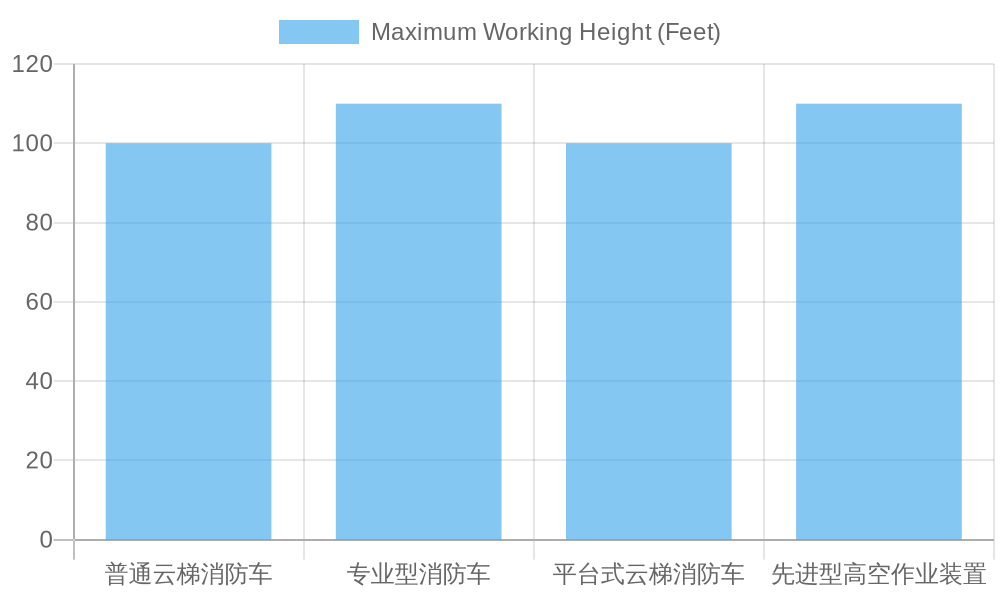
This chart illustrates the varying maximum working heights of several fire truck ladders useful for aspiring firefighters and enthusiasts alike!
The Technology Behind Fire Truck Ladders
Modern fire truck ladders are engineering marvels that blend advanced technologies to ensure optimal performance and safety for firefighters. Central to these innovations are hydraulic systems, which allow for smooth and precise operation of telescoping and articulating booms. Modern ladders utilize multi-stage hydraulic systems with redundant safety circuits and electro-hydraulic servo control, enabling responsive movements essential for rapid deployment in emergency situations (Fire Engineering Magazine).
Another remarkable innovation is the use of high-tech materials. Today’s ladders are often constructed from aerospace-grade aluminum alloys and carbon fiber-reinforced composites. These materials reduce the weight of the ladders by up to 40% while enhancing strength and durability, allowing them to reach remarkable heights of around 100 meters (Global Fire Truck Market Report 2023).
Safety is paramount in firefighting operations, and modern fire truck ladders come equipped with several vital features. Real-time load monitoring systems can detect overstress conditions and automatic leveling systems compensate for uneven surfaces. Additional advancements include obstacle detection using LiDAR, integrated thermal imaging cameras for visibility in smoke, and GPS-based systems for route optimization and stability detection. These innovations significantly enhance operational safety and efficiency, making firefighting operations quicker and more secure.
Famous Fire Truck Ladder Models
Fire truck ladders are a marvel of engineering, designed to reach high altitudes and perform in challenging firefighting situations. Here’s a list of notable models that are well-known in the firefighting community:
| Model | Manufacturer | Key Features |
|---|---|---|
| Sutphen 95′ Rear-Mounted Aerial Ladder | Sutphen Corporation | 95-foot telescoping boom capable of 360-degree rotation, highly favored in metropolitan areas. |
| Magirus M640 | Magirus GmbH | 36-meter telescopic aerial platform with a 50-meter outreach, designed for high-rise firefighting safety. |
| Boreal K18 Curved-Arm Aerial Ladder | Boreal Fire Equipment | Compact design with an 18-meter reach, capable of bending around obstacles for urban firefighting. |
| Seagrave Predator II | Seagrave Fire Apparatus | 105-foot extendable ladder with a high mobility chassis, ideal for rapid deployments in emergencies. |
| Jietong Firefighting 32 m Aerial Ladder | Jietong | Features a hydraulic turntable with high strength materials, optimized for urban construction fire rescue. |
| 91-Meter Aerial Ladder | Chinese Manufacturer | Innovative ladder reaching up to 91 meters, equipped with multiple safety systems for urban emergencies. |
These models showcase the technology and design innovations in the firefighting industry, enabling crews to effectively combat fires from greater heights. For a deeper dive into the evolution of fire truck designs, check out our blog.
Challenges Faced by Ladder Operators
Operating a fire truck ladder is no simple task, and the challenges faced by ladder operators during emergency rescues and firefighting efforts can be daunting. From positioning to dealing with environmental factors, there’s much at stake in those critical moments.
Positioning Protocols
One of the most significant challenges is effectively positioning the ladder truck. Ladder operators must maneuver the vehicle into tight spots, often in chaotic urban environments. For instance, when responding to a fire in a densely populated area, it’s not uncommon for operators to encounter parked cars, pedestrians, and other obstacles that complicated positioning. Anecdote: Consider a scenario where an operator needed to position a ladder truck in a narrow alley to reach a fire on the upper floors of an apartment building. The challenge was not merely the height but ensuring the angle of extension was safe and the ground was stable enough to sustain the ladder’s weight.
Wind Factors
Wind plays a crucial role in ladder operations. According to the National Fire Protection Association (NFPA), when wind speeds exceed 20 mph, the safety of ladders comes into question. Ladder operators must monitor wind conditions continuously and position the truck strategically to minimize exposure to gusts. For example, in high-rise situations, wind can create lateral forces affecting ladder stability, increasing the risk of tipping. Operators often have to decide whether to deploy the ladder or wait for better conditions.
Operational Limits
Adding another layer to the complexity, every aerial ladder has its operational limits. Most fire departments have strict protocols, dictating how high and far ladders can extend based on various factors, including wind conditions and the terrain. The International Association of Fire Chiefs (IAFC) indicates that in harsh weather, operators may need to restrict the ladder’s outreach to maintain stability, which can be particularly troublesome in emergencies requiring immediate access to upper floors.
In conclusion, fire truck ladder operators must be adept at handling multifaceted challenges, navigating the delicate balance between effective firefighting and maintaining safety protocols. Their ability to adapt under pressure signals not only their skill but also their commitment to saving lives.

This chart visually represents the ladder reach of various fire truck models, showcasing the impressive capabilities of aerial ladder trucks, including the Isuzu 6×4 series and the Foton Fire Truck.
Key Takeaways:
- Aerial Ladder Truck (General): Ladder reach varies between 32m to 53m, ideal for high-rise firefighting operations.
- Isuzu 6×4 Series Fire Truck: Maximum height of 42m for effective urban operations.
- Foton Fire Truck: More compact with a reach of 32m, suitable for mid-range applications.
For more information on fire truck models, consider checking out our guide to choosing the best fire truck model for every need.
In conclusion, understanding the capabilities of fire truck ladders is crucial for both aspiring firefighters and those passionate about fire fighting technology. Modern fire service operations frequently require access to high-rise buildings, and the ability to reach significant heights can make a pivotal difference during emergencies. With advancements in ladder technology, such as those seen in vehicles that can extend up to 100 feet or more, firefighters can effectively conduct rescues, deploy aerial firefighting equipment, and navigate complex urban terrains.
These ladder systems not only enhance safety and efficiency but also represent a critical component of modern firefighting strategies. Fire departments must invest in training and equipment that prepares their teams for these challenges, ensuring that firefighters are proficient in leveraging these tools during critical situations.
For fire truck enthusiasts and collectors, appreciating the engineering behind these ladders adds another layer of admiration for these vehicles. To further explore this fascinating aspect of firefighting equipment and how it aids in life-saving operations, visit our blog for in-depth articles and discussions. If you’re looking into customizable solutions that meet diverse firefighting needs, check out our offerings. Enjoy your journey in fire safety and technology!
The Importance of Ladder Technology in Modern Firefighting
Ladder technology has transformed the capabilities of firefighting teams, allowing them to efficiently tackle high-rise emergencies and engage in complex rescues. The advancements seen in modern fire truck ladders not only emphasize reach but also enhance safety and operational effectiveness.
“The evolution of extension ladders-from manual pulley systems to hydraulically assisted, multi-section designs-has directly enhanced firefighter safety and operational efficiency. Today’s ladders are engineered with lightweight composites and precision stabilization systems, allowing for safer access to upper floors while reducing physical strain. Without advancements in ladder technology, many urban rescues would be impossible or far more dangerous.”
- Dr. Elena Martinez, Chief Fire Safety Engineer at the National Fire Protection Association (NFPA)
Modern fire truck ladders can reach impressive heights, typically ranging from 75 to over 100 feet. With specialized models, some extend even higher, offering critical access during emergencies. Fire departments continue to invest in advanced ladder technology to ensure they are prepared for any situation. Here are some key benefits of contemporary ladder systems:
- Enhanced Reach: Many modern ladders extend far beyond traditional limits, enabling access to multi-story buildings that pose significant risks.
- Improved Stability: Advanced stabilization systems minimize sway and improve safety during operations, especially in adverse conditions.
- Reduced Physical Strain: Lightweight materials help lessen the burden on firefighters, allowing them to operate ladders for longer durations more effectively.
For fire truck enthusiasts and professionals, keeping abreast of these advancements is crucial. To explore more about the latest in firefighting technology, learn more about firefighting equipment.
