
Fire trucks are among the most iconic and crucial vehicles in emergency services, designed to save lives and protect property. Understanding how much a fire truck weighs is essential for firetruck enthusiasts, aspiring firefighters, and professionals in firefighting services. Fire trucks come in various configurations and styles, from light rescue vehicles to massive ladder trucks, and their weight specifications play a critical role in operations, safety, and regulations. This comprehensive guide will delve into the weight specifications of fire trucks, explore the factors that influence their weight across different models, and examine the practical implications of these weights on firefighting operations and safety standards.
Weighing the Firefighting Goliath: How Mass, Machinery, and Mission Define a Fire Truck’s Weight
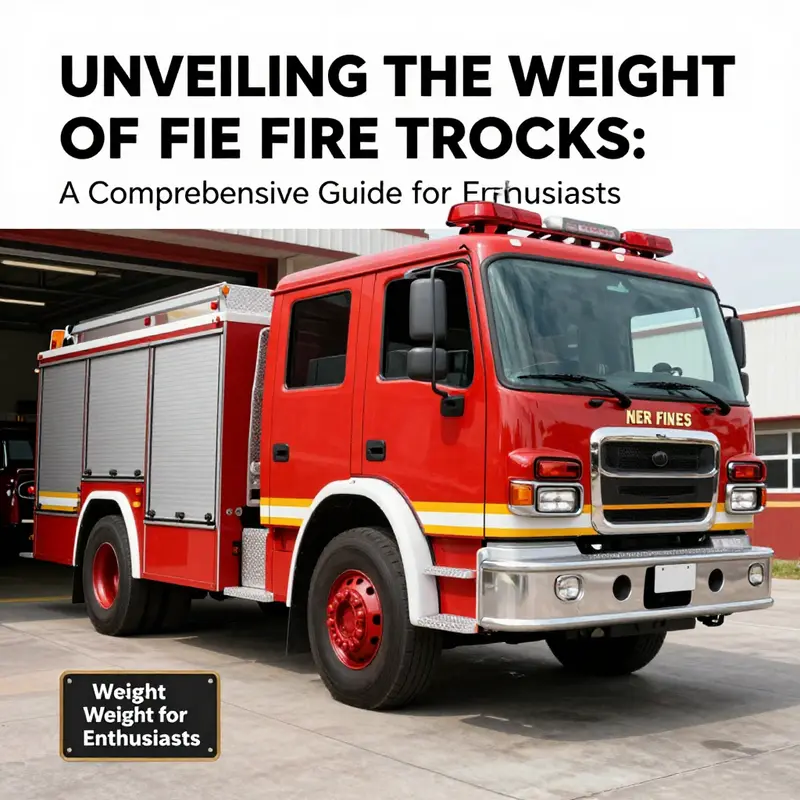
Weight is not a single number but a spectrum that shifts with purpose, design, and the loads a fire department expects a vehicle to bear in the field. When people ask how much a fire truck weighs, they are really asking about a family of numbers: the curb weight—the mass of the truck as it ships out of the factory, with no cargo or passengers—and the gross vehicle weight, which rises as the vehicle takes on water, hoses, pumps, ladders, and crew. In the real world, those figures do not sit in isolation. They are bound to the vehicle’s role, the water it carries, the equipment it must deploy, and the terrain it must traverse. The resulting weights can vary widely, and that variation matters as much as the numbers themselves. To understand why a fire truck weighs what it weighs, one must follow the chain from core chassis to the last hose nozzle and the live battle they are about to mount against a fire. The legacy of the weight is not simply engineering; it is operational philosophy made visible in steel and liquid.
At a practical level, the numbers you will encounter start with a modest baseline and then climb as capacity and capability are added. A common baseline is the curb weight, which can be thought of as the vehicle’s own body minus any cargo or crew. When you see a curb weight in the realm of roughly 11,800 kilograms, you are looking at a chassis that is built to carry substantial loads but currently has only its own mass, the basic structural skeleton, the engine and transmission, and the standard apparatus that comes with the vehicle in its unloaded state. The GVW, or gross vehicle weight, then tells the rest of the story: it marks the maximum permissible weight when the truck is loaded to perform its mission. In the examples typically discussed in catalogs and spec sheets, a GVW around 19,850 kilograms to 19,870 kilograms represents a loaded configuration where water tanks, pumps, and equipment have all joined the mass tally. When a vehicle is described in terms of a curb weight of 11,800 kg and a GVW near 19,850 kg, the delta—roughly 8,000 kilograms or more—corresponds to the water, gear, and the crew that the unit must carry to fight a blaze, respond to a rescue, or support a large-scale incident. Beyond these two anchors, there is a broader landscape of weights that reflect the full diversity of fire apparatus.
The weight of the fire truck grows not only with its capacity to hold water but with the very logistics of firefighting itself. Water is the most obvious weight contributor. Modern pumpers and tankers are designed to carry thousands of liters of water; even when the public’s perception centers on gallons and gallons, the underlying physics is straightforward: water adds mass, and mass demands power to move, steer, and stop the vehicle safely. A tank that can hold several thousand liters adds hundreds or thousands of kilograms to the vehicle’s total mass. Pumps, piping, hoses, and fittings, while necessary for creating pressurized discharge, add their own weight, especially when designed to withstand the demands of high-flow operations and long runs with multiple lines running concurrently. The ladders, rungs, and aerial assemblies carry significant mass as well; in many configurations, the heavier the apparatus, the more complex the stowage and deployment systems become, and the more robust the braking and suspension requirements must be. It is the combination of these components—tanks, pumps, ladders, and hoses—that pushes a base chassis toward a loaded weight that can approach the higher end of the spectrum.
In practical terms, the weight spectrum for fire apparatus starts near the low end at about ten tons for smaller or lighter-duty fire response vehicles. These compact engines can be optimized for urban responses, rapid notification, and quick deployment across tight streets where maneuverability matters more than sheer water capacity. On the other end of the spectrum, larger, more capable units—the aerial ladder trucks and the multi-role pumper-tankers—tend to surpass twenty tons. They are designed to deliver greater water volumes, reach elevated locations, and sustain operations in extended incidents where the mass of water and gear can stretch the limits of the chassis. Between these two extremes lies a broad middle ground, where a typical heavy-duty fire engine settles around the fifteen-ton mark. This “mid-range” weight reflects a balance: enough water to sustain a multi-line attack, ample pump power for high-pressure delivery, and enough reserve mass to carry rescue tools, personal protective equipment, and a crew, all while still maintaining adequate braking performance, tire load capacity, and stability.
Yet even these generalized numbers tell only part of the story. The exact weight of any given fire truck is a function of its configuration and the choices a fire department makes about equipment, crew, and mission profiles. A unit outfitted for rural wildland-urban interface work, with cross-country wheels, specialized water tenders, and extra fuel for extended responses, will present a different weight profile than a compact urban pumper designed for rapid response to city blocks. The water tank itself can be a decisive factor: a larger tank means more water to carry, but it can be offset by a lighter pump arrangement or by more compact framing choices. The structural material is another critical variable. A significant portion of a fire apparatus’s weight derives from the chassis and body, which are typically steel or other heavy alloys; lighter materials save mass but may require different design trade-offs for strength and durability. The choice of body construction, whether it emphasizes steel for rugged durability or lighter alloys for payload efficiency, subtly shifts the baseline, the loaded weight, and even the vehicle’s center of gravity.
The interplay of weight and performance is not a mere technical curiosity; it has direct implications for the way a fire department uses the vehicle. Heavier vehicles demand more energy to accelerate and decelerate; they require longer braking distances and larger, more robust brake assemblies. They need tires with higher load ratings and more sophisticated suspension systems to manage the weight without compromising ride quality or control. In the field, where roads can be slick, uneven, or congested with other responders, the weight distribution informs how the truck negotiates curves, climbs grades, and stops at critical moments. Weight intrinsically affects the vehicle’s stopping power, the responsiveness of its steering, and the stability of its platform when ladders and water streams are deployed. These dynamics underscore why weight is a primary design constraint and why different fire services tolerate different weight envelopes in pursuit of diverse mission goals.
Consider the everyday realities of operating at a scene where a full load might include hundreds of gallons of water, hundreds of gallons of foam concentrate or other suppressant, hoses snaking across the ground, and a crew moving in and out through doors and ports. The vehicle’s weight, in that moment, is not just a static statistic; it is a live factor that shapes everything from where the apparatus can be positioned to how quickly a pump can begin delivering water to the nozzle. A heavier unit often needs to back away from a hydrant further to avoid overloading the rear axle while maneuvering into a tight space. It may require a more deliberate, staged approach to pump operations, with careful attention to the distribution of weight as water is released into hoses and as reels are activated. The science of weight, in other words, becomes theater in the field, with momentum, balance, and gravity performing alongside the firefighters who operate the equipment.
In the broader context of the fire service, the numbers that define a fire truck’s weight are also a window into the design philosophy behind the apparatus. A plausible, common estimate is around fifteen tons, a figure that captures a practical compromise between capacity and maneuverability. This centrist weight seldom arises by accident; it reflects a deliberate decision to equip a vehicle with enough water and fire suppression capability to perform effectively while remaining within the limits of typical urban and suburban road networks. When a department calibrates its fleet around this middle ground, it preserves the ability to deploy quickly, to reach a broad range of addresses, and to sustain operations without facing excessive fatigue during long incidents. The balance is not about minimal mass but about an optimal mass—the point where payload, power, and handling converge to create a reliable workstation on wheels.
One way to appreciate the weight story is to consider the structural and material choices that define steel fire apparatus. The steel framework and hull, the water tank, the pump base, and the numerous equipment bays all contribute to mass, but they also enable reliability and resilience. The steel construction is chosen for its strength, ductility, and longevity, especially in demanding environments where impacts and rough road conditions are not uncommon. This choice reinforces why weight is a deliberate parameter in the design process and why it must be harmonized with the vehicle’s intended service life, maintenance intervals, and the geographic and regulatory context in which it operates. A closer look at the structural assembly reveals how mass is not merely a downside to be tolerated but a functional attribute that supports the crew, the water, and the tools that make a difference in a life-and-death scenario. For readers who want to explore this dimension of the topic, a deeper dive into steel fire apparatus specifications offers a practical lens on how mass, materials, and design interact across different fire services.
Beyond materials and capacity, there is a methodological layer to weighing fire trucks: how the numbers translate into usable performance data. The curb weight gives a baseline for the vehicle’s inertial properties and fuel efficiency, while the GVW anchors the legal and safe operating envelope. In many jurisdictions, the GVWR specified by the manufacturer becomes the limit used for licensing, highway routing, and maintenance planning. This is not merely bureaucratic chatter; it anchors the decisions behind fleet deployment, fuel strategy, and even the allocation of repair resources after an incident. When a department evaluates a new vehicle, the weight profile is cross-checked against the infrastructure it will navigate—bridges, overpasses, and roadways with height and weight restrictions. The weight is also a factor in the vehicle’s ability to carry alternative payloads, such as foam systems, additional rescue equipment, or specialized stabilization gear that may be necessary for particular incident types. The practical outcome is that weight informs not only how much water a truck can carry, but how it integrates into the broader emergency response system.
To ground these ideas in a tangible reference point, consider a published example from the catalog of heavy-duty water support vehicles, one that describes a six-ton class water fire truck as a representative of a mid-range capability. This kind of specification helps illustrate how a compact yet capable engine can deliver meaningful firefighting performance without crossing the threshold into the heavier categories. While the exact numbers differ from one manufacturer to another and from one market to another, the underlying relationships hold: more water means more weight, a heavier platform imposes greater demands on braking and handling, and the mission profile shapes how much mass is acceptable and necessary. For readers who want a concrete external reference that bridges the general principles with real-world dimensions, an external resource provides a useful data point about similar vehicle classes and their weight characteristics: https://www.alibaba.com/product-detail/HOWO-6-Tons-Water-Fire-Truck-4X2-Fire_1600597877553.html.
The weight discussion is not self-contained. It sits alongside considerations of maintenance, lifecycle costs, and the logistics of equipment transport. Heavier apparatus require more substantial support during service intervals, more robust materials for wear parts, and longer lead times for parts that must match the mass and suspension profiles. At the same time, heavier vehicles can benefit from larger power reserves, better stability when fully loaded, and enhanced durability for long-term use in challenging environments. These trade-offs are not abstract; they shape the standards by which fire departments procure, maintain, and retire equipment. The weight dimension thus becomes a practical translator between the abstract realm of performance figures and the everyday operations that define a department’s effectiveness.
In day-to-day terms, many readers will encounter weight data in the form of specification sheets. Those sheets typically present a snapshot: the curb weight, the gross vehicle weight rating, tank capacity, pump performance, and a summary of the equipment that accompanies the vehicle. To interpret these numbers, it helps to visualize the moment of deployment. Imagine a well-coordinated team arriving on a street with hydrants nearby, limbs of ladders secured, and a battalion of hoses ready for deployment. The engine must accelerate with momentum, then come to a controlled stop as the crew begins to work. The water flows, the foam begins to foam, and the weight of the system begins a dynamic choreography with the road. The driver and crew are not passive; they are actively managing mass in motion. The tires, suspension, brakes, and steering system must respond with precision, all while the water and gear shift the vehicle’s center of gravity. The result is a living, responsive platform where weight is both constraint and enabler. This is why the weight envelope matters for the full lifecycle of the vehicle—from purchase to maintenance to retirement—and why understanding the weight profile is part of understanding the fire service as a whole.
As readers explore these concepts, the notion of a typical weight becomes a heuristic rather than a single, fixed value. The numbers—11,800 kg curb weight, 19,850 kg GVW, 19,870 kg GVW in another configuration—are reference points that help fire services compare options, forecast performance, and plan for the infrastructure required to support their fleets. They are not universal absolutes because the weight is inseparable from the mission. A department serving a city with narrow streets and limited hydrants may favor a lighter configuration that prioritizes speed and maneuverability over water capacity. A rural department defending large open spaces and long access routes may opt for heavier models with larger water tanks and more robust rescue tools, accepting the trade-off of higher mass. The spectrum is a reflection of the diversity of fire protection demands, not a single standard.
If a reader wants a consolidated takeaway, it is this: weight is a defining feature that reflects purpose, not a mere byproduct of design. The same chassis can be adapted across contexts by adjusting tank size, pump capacity, and equipment storage, producing a family of weights that share a common core but diverge to meet local needs. The numbers matter mainly as a tool for planning, budgeting, and safety. They guide where a unit can operate, how it will perform in critical moments, and how fleets can be coordinated across stations to ensure every response is proportionate to the threat. This is the essence of why even seemingly simple questions about a fire truck’s weight demand careful context and thoughtful interpretation, because the answer depends on the intersection of physics, engineering, and service philosophy that defines modern firefighting.
For readers seeking a concise link between mass, capacity, and field readiness, the weight narrative has a practical payoff: it informs how departments stage, route, and deploy their apparatus in the service of public safety. The mass of a fire truck is not just a figure in a catalog. It is a measure of how much water can be brought to bear, how swiftly the team can act, and how safely the vehicle can be controlled while performing a high-stakes operation. As you consider the numbers, you are also weighing the human factors—the crew, the teamwork, and the discipline required to operate within a vehicle whose mass is a core part of its capability. And when those factors align with a well-understood weight profile, the result is a more reliable, more effective response—an essential ingredient in any successful firefighting effort.
External Reference: https://www.alibaba.com/product-detail/HOWO-6-Tons-Water-Fire-Truck-4X2-Fire_1600597877553.html
The Heavy Truth Behind Readiness: How Fire Truck Mass Varies by Model, Chassis, and Equipment
Weight is more than a number on a spec sheet; it defines how quickly a fire vehicle can respond, how it handles on bridges and tight streets, and how much gear it can carry. The weights you see on brochures reflect two numbers: curb weight, the truck itself, and gross vehicle weight, the maximum allowed when loaded with fuel, water, crew, and equipment. Across models, curb weights might range from about 9,000 kg to over 15,000 kg, while GVWs commonly fall between 16,000 kg and 30,000 kg depending on water capacity, ladders, and rescue tools. A modern pumper with a medium water tank sits toward the lighter end, while aerial ladder platforms and heavy rescue rigs push higher because of training equipment and stability needs.
Two trucks with the same GVW can feel different depending on weight distribution, with front axle load and rear axle load affecting steering and braking. Water is heavy: every gallon adds mass; a 1,500-gallon tank adds roughly 5,670 kilograms of water, which substantially raises loaded mass. The design challenge is to balance payload, power, and handling so that the vehicle can perform reliably under emergency conditions.
Materials and construction choices matter: aluminum bodies and lighter tank shells can trim mass, while reinforced frames, ladders, and specialized rescue gear push mass upward. Heavier apparatus often use more robust braking systems, stronger suspensions, and larger tires, all of which influence maintenance and fuel use. Standards bodies, such as the NFPA, provide guidelines on weight and loading to help departments select apparatus that aligns with local road networks and expected duty cycles.
The practical implications are clear: heavier trucks demand more capable brakes, suspensions, and tires, may incur higher fuel costs, and require more extensive driver training and maintenance. Lighter configurations can offer faster acceleration and lower road wear, but may require different water strategies or additional equipment to achieve the same on-scene capability. In either case, thoughtful mass management—through materials, layout, and component choices—helps crews reach incidents quickly and operate safely.
In summary, fire truck weight is a deliberate design parameter, not a fixed constant. It reflects mission requirements, infrastructure realities, and the ongoing tradeoffs between payload and mobility.
Mass in Motion: How Fire Truck Weight Shapes Response, Safety, and the City’s Fabric
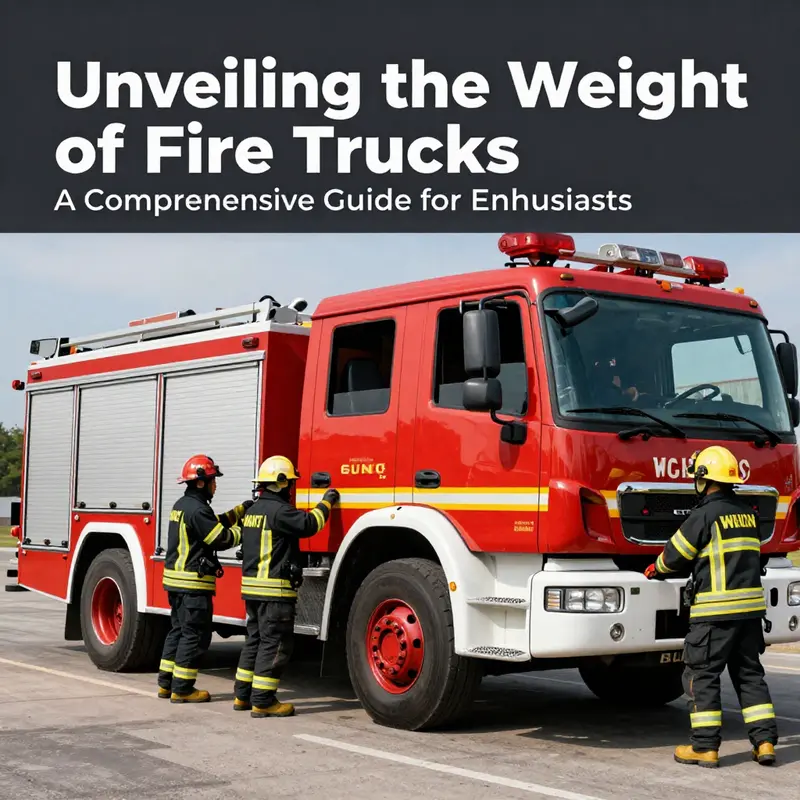
Weight is more than a number on a spec sheet. In the world of firefighting, it is a dynamic constraint that ripples through every facet of how a truck moves, how quickly it arrives, and how safe the mission stays for the crew and the civilians they protect. A fire apparatus sits at the nexus of engineering and field practice: it must carry water, pumps, hoses, and tools; it must still be able to accelerate, brake, and steer with precision; and it must travel through a city’s streets, across bridges, and into neighborhoods where every second matters. When we talk about the weight of a fire truck, we are talking about a carefully balanced design problem. The curb weight—or the weight of the vehicle itself without cargo or people—often lands in the vicinity of around 11.8 metric tons for standard configurations, while the gross vehicle weight, the total weight when fully loaded with water, equipment, and crew, pushes toward the upper end of the near 19.8 metric tons range. These figures are not abstract arithmetic; they reflect the tradeoffs fire departments must manage between capacity and mobility, safety and reach, robustness and agility.
To understand why weight matters so profoundly, imagine the core purpose of a fire engine: to deliver water where it is needed, rapidly, with enough pressure to interrupt a spreading blaze and to do so in a manner that preserves the safety of everyone on the street. The mass of the vehicle stems from several sources. Water itself is a substantial portion of a traditional apparatus’s load when the tank is full. Pumps, hoses, extinguishing agents, and high-pressure equipment add to the mass. The chassis and structural reinforcements that allow a heavy vehicle to sustain years of service and survive in the harsh conditions of emergency response also contribute. Even the compartments and the equipment stowed within them add grams and kilograms that accumulate into a heavy, purpose-built tool at the curbside. The result is a machine that is powerful and resilient, yet inherently less nimble than a lighter vehicle—an irony that underpins every decision about deployment and tactics in the field.
This tension between capacity and maneuverability becomes especially visible in the realities of urban response. Heavier fire apparatus tend to carry more water and more pump capacity, which can be a boon in certain scenarios where a distant or well-involved fire demands sustained application. But the same heavy mass translates into slower acceleration off the line, longer braking distances, and more challenging cornering dynamics. The physics are unforgiving: a heavier vehicle needs more time and distance to come to a complete stop, more room to change direction, and more thoughtful planning to avoid compromising streets, pedestrians, and other vehicles. On slippery surfaces, where traction is already compromised, the weight compounds the risk of skidding or hydroplaning, particularly when sudden maneuvers are required to avoid obstacles or to reposition after an initial attack. For the operator, this translates into heightened vigilance, slower response improvements, and a need for strategic positioning that reduces the likelihood of late-stage corrections in high-stakes environments.
The weight discussion also intersects with the urban infrastructure that supports emergency response. Bridges and overpasses, roadways with strict weight limits, and even the materials that make up street surfaces must bear the loads they receive during a typical call. Heavier trucks exert greater stress on pavements and structures, a reality that might influence route planning, gear distribution, and even the way command staff maps response corridors. In dense city cores, where weight limits and corridor widths are common, the ability to reach a scene quickly can hinge as much on how a vehicle’s mass is managed as on how fast the siren blares. This is not the stuff of theory; it translates into real-world decisions about whether to send a fully loaded unit or to dispatch alternative units to secure water sources, draft points, or specialized equipment first, and then bring in a heavier apparatus once the initial access is established.
From the driver’s seat, weight shapes perception and performance in tangible ways. Simulation and field observations alike show that heavier apparatus often exhibit a different acceleration profile, requiring more careful throttle management and anticipation of traffic dynamics. Braking demands are higher, necessitating earlier braking inputs and closer following distances. The steering feel can be heavier, and the turning radius larger, which complicates the pursuit of optimal routes through congested streets or around tight intersections. These characteristics naturally feed into the planning of responses: the dispatcher may need to pre-emptively allocate alternate routes, or elevate the priority of on-scene water supply logistics to reduce the time the heavy vehicle must operate at the extreme ends of its performance envelope.
Trajectories tell a compelling story about weight in the wild. A body of empirical research that analyzes the movement patterns of fire truck responses reveals that heavier vehicles tend to exhibit lower average speeds, more frequent deviations from the most direct routes, and a higher propensity to adjust paths in response to perceived handling constraints. In practical terms, this means the value of a fully loaded apparatus is a careful function of geometry, road topology, and the situational demands of the incident. If a city manager wants to minimize total response time, weight considerations should be integrated into the broader logistics framework—how water is supplied, how equipment is staged, and how backup units and mutual-a aid plans are configured to ensure that the most weighty assets do not bottleneck the mission at key chokepoints. These insights are grounded in robust trajectory analyses and have implications for both urban and rural settings alike, where road grades, pavement conditions, and bridge clearances can amplify or dampen the effects of mass on movement.
In some ways, weight is a lens through which we can examine the entire firefighting system, not just the truck. A heavier vehicle tends to shift the balance of risk and reward in the same direction across several dimensions: it can deliver greater sustained operations, but it may demand longer planning horizons and more rigorous maintenance. It can benefit from more sophisticated firefighting apparatus and larger water tanks, yet it may push crews toward higher energy demands and more frequent mechanical checks. Maintenance costs naturally rise with mass because more energy is expended to initiate movement, sustain operation, and stop safely. The wear-and-tear cycle can be more pronounced on brakes and transmission components, particularly when the vehicle regularly operates in stop-and-go urban environments or on grades where engine braking is a recurring duty. This dynamic is not merely theoretical; it influences budgeting, maintenance scheduling, and even the training programs that prepare crews to monitor and manage vehicle health during long deployments.
For departments weighing equipment choices, the trade-off between expanded capacity and retained mobility becomes a core strategic question. A heavier apparatus can be equipped with broader firefighting tools, more robust pumping systems, and larger water reserves, but the operational cost of that design is borne in the speed of response and the ease with which crews can reposition on arrival. To address this, many agencies pursue a systems approach: modular or tiered configurations that can adapt to the incident’s needs, selective use of lighter auxiliary units to secure critical tasks, and the development of protocols that optimize route selection and on-scene logistics so that the heavier elements do not dominate the scene before water is flowing and hose lines are deployed. In practice, this means crews plan for a two-tier response strategy in which a lighter, more maneuverable vehicle or set of vehicles begins the attack while the heavier apparatus comes in to deliver sustained water supply and specialized capabilities. The design of such strategies benefits from an intimate understanding of weight dynamics and its consequences for acceleration, braking, and handling under a range of weather and road conditions.
The research-driven perspective on trajectory and performance adds another layer to the conversation. A recent peer-reviewed analysis focusing on fire truck emergency rescues underscores how weight shapes trip characteristics like average speed, route selection, and stop-and-go patterns. The study shows that heavier trucks are more likely to deviate from the most direct routes—a practical outcome of handling limitations and the need for cautious driving under load. This doesn’t argue against heavy equipment; it argues for smarter management of mass within operational planning. If a city’s emergency services aim to shave seconds from response times, they must balance the fact that heavier apparatus provide greater on-scene capacity with the reality that the same mass can slow arrival. In other words, weight is a lever, not a verdict. It invites engineers, planners, and incident commanders to design with mass in mind, using route optimization, staged deployment, and equipment configuration to preserve speed where it matters most.
The broader implications extend to the street level as well. Heavier trucks exert greater forces on the pavement and bridge decks as they accelerate, brake, and corner. Over time, those loads contribute to wear patterns that repair crews must address. When communities set weight limits, they are not merely restricting vehicle size; they are protecting infrastructure that supports essential public safety work. For emergency services, these considerations often translate into careful judgment about which routes to take, which hydrants to rely on first, and how to position units so that the arrival of the heavier components aligns with the moment when water and manpower become decisive on the fireground. In practice, commanders may prefer to stage resources near the most favorable access points and avoid routes that impose unnecessary mass on fragile segments of the network. The aim is not to minimize weight at all costs but to maximize the effectiveness of every pound by integrating vehicle capabilities with planning, routing, and incident command.
As departments think about future upgrades, the conversation naturally turns to how design choices can soften the performance penalties of mass. There is no one-size-fits-all answer, but several guiding principles emerge from the convergence of engineering insight and field experience. First, lightweight materials and structural optimization can reduce the overall curb weight without compromising safety or durability. Second, modular equipment configurations enable crews to tailor payloads to the incident, delivering critical water, foam, or dry chemical capacity only when it is needed at a given scene. Third, alternative water management strategies, such as dedicated aerial platforms, external water sources, or strategic water shuttle plans, can lessen the burden on the vehicle during long incidents. Fourth, modern communications and navigation technologies help crews choose routes that minimize exposure to heavy loads, adjusting in real time to traffic conditions and road restrictions. Finally, ongoing training that emphasizes weight-aware driving, aggressive yet safe braking, and precision maneuvering becomes essential for every operator who must guide a heavy asset through a dynamic cityscape. These themes collectively suggest that weight management is not simply a matter of choosing a bigger tank or a heavier chassis; it is about shaping a capable, resilient firefighting system that can pivot between capital-intensive capacity and agile, rapid response when every second counts.
For readers curious about how the market responds to weight and capacity considerations, the firefighting vehicle marketplace reflects a thoughtful balance between demand for larger, more capable engines and the practical need for maneuverability. Listings and advertisements for fire apparatus frequently emphasize compatibility with urban environments, including details about water capacity, pump ratings, and braking systems, while underscoring the importance of safe handling and maintenance. This is a reminder that the weight conversation is not purely technical; it has direct implications for procurement, deployment, and the long-term sustainability of emergency services. In exploring these dynamics, readers can examine how equipment configurations are described and marketed in a way that signals reliability, versatility, and readiness for a wide range of incidents. It is a reminder that the weight of a fire truck is not just a number. It is a signal about how a city plans, how crews train, and how the built environment is prepared to support life-saving work under pressure.
To anchor these reflections in concrete evidence, consider the trajectory-focused study that informs much of today’s operational thinking. The research emphasizes that heavier fire apparatus influence trip characteristics in measurable ways, reinforcing the call for integrated planning across vehicle design, routing, and on-scene tactics. While the figures and models come from rigorous analysis, the implications are practical and immediate: weight should be a central variable in how emergency services prepare, respond, and recover from incidents. This is not about choosing weighty gear for its own sake; it is about calibrating every element of the response to align with situational needs, road realities, and the overarching mission to save lives and protect property with speed, precision, and safety.
For those exploring how departments balance this complex equation in the field, a useful entry point is the broader commentary on vehicle acquisitions and the ongoing evolution of firefighting fleets. It underscores that decisions about mass are inseparable from broader considerations of incident command, resource management, and community resilience. If readers want to connect these ideas to real-world options and see how agencies discuss weight in the context of procurement and deployment, they can explore industry discussions and market listings that frame capability in terms of resilience and readiness. This perspective helps bridge the gap between theory and practice, showing how weight, when understood and managed well, becomes a critical enabler of effective emergency response rather than a constraint that hampers it.
In sum, the weight of a fire apparatus is a defining characteristic that permeates technical performance, on-scene tactics, and the larger urban ecosystem. It shapes how quickly trucks accelerate, how safely they brake, and how reliably they can be steered through crowded streets. It informs the wear placed on road surfaces and bridges, influencing planning decisions about routes, staging, and infrastructure maintenance. It affects the economic calculus of maintenance and fuel consumption, as heavier vehicles demand more energy and longer service life cycles for braking systems and transmissions. And it frames the strategic thinking behind equipment design and deployment: the only way to sustain rapid, safe, and effective response in a complex city is to balance the ambitions of capacity with the realities of mass. This balancing act—between the mass that enables firefighting citywide and the nimbleness necessary to reach a blaze fast—defines not just a chapter of equipment physics but a living map of how modern fire services think about readiness, safety, and service to the public.
External resource for further context on the trajectory-based effects of weight on fire truck responses: https://www.sciencedirect.com/science/article/pii/S019126152500048X
If you want to explore market availability and how different configurations are marketed to achieve the right balance of weight and capability, consider examining the broader industry landscape through dedicated resources that catalog and compare firefighting vehicles. For practical context and community-relevant options, see the cataloging pages and sale listings that curate a range of apparatus with varying capacities and mass, which can help illustrate how weight considerations translate into real-world procurement decisions. This is particularly useful for departments facing urban constraints, weight-limited corridors, and the need to deploy high-capacity equipment without compromising on speed and maneuverability. For more background on current market offerings and situational considerations, you can browse the relevant pages that discuss fire apparatus for sale and related equipment.
Anchoring the discussion in the data and in field practice, it becomes clear that the weight of a fire truck is not a single metric to be optimized in isolation. It is a composite of design choices, infrastructure realities, and tactical demands. The most effective fleets are those that recognize weight as a central variable in planning, training, and operations—one that is continually negotiated through improvements in materials, propulsion, hydraulics, routing, and incident management. In that sense, weight is not a barrier to speed but a signal to structure readiness in a way that respects both human limits and the built environment. When weight is understood in this light, the result is not stagnation but a more resilient, adaptable, and capable firefighting system that can respond to the massed challenges of a modern city with confidence and care.
Final thoughts
Understanding the weight of fire trucks is a fundamental aspect of firefighting that affects everything from operational efficiency to safety standards. As we’ve explored, the weight specifications, influenced by various factors including model and equipment, are critical for ensuring effective firefighting and emergency response. For firetruck enthusiasts, aspiring firefighters, and professionals, knowledge of these weights not only enhances appreciation for the vehicles but also informs decisions related to safety and operational protocols. As you continue your journey in the world of firefighting, remember that every detail, including weight, contributes to saving lives and protecting communities.